Walk into any aesthetic clinic in 2026 and you’ll be offered four different “Botox-like” treatments — and the differences between them are real. Choosing the wrong neuromodulator for your face, your timeline, or your budget can mean dull results, faster wear-off, or an unnecessary expense. This guide breaks down the four major FDA-approved neuromodulators available in the U.S. — Botox, Daxxify, Dysport, and Xeomin — so you can walk into your next appointment knowing exactly what to ask for.
This content is for educational purposes only and does not constitute medical advice. Individual results may vary. Consult a qualified healthcare provider before undergoing any treatment or procedure.
What All Neuromodulators Have in Common
All four products are forms of botulinum toxin type A, the same active molecule used in clinical and cosmetic medicine for decades. Each one works the same fundamental way: by temporarily blocking the nerve signal that tells a muscle to contract, softening the wrinkles created by repeated facial expression. All four are FDA-approved for cosmetic use in the United States. Where they differ is in their molecular structure, onset time, duration of effect, and ideal use cases — and those differences are exactly what determines which one is best for you.

The Quick Comparison Table
Here is a head-to-head look at the four products. Use this as a quick reference, then read the deep dives below.
| Feature | Botox | Daxxify | Dysport | Xeomin |
|---|---|---|---|---|
| Onset (visible results) | 7–14 days | 1–2 days | 2–3 days | 4–7 days |
| Duration | 3–4 months | 6–9 months | 3–4 months | 3–4 months |
| Spread | Localized | Localized | Wider spread | Localized |
| Accessory proteins | Yes | Peptide-based | Yes | None (“naked”) |
| Best for | Gold standard, all areas | Long-lasting results, severe lines | Larger areas (forehead) | Sensitive patients |
| Approx cost (per unit) | $13–18 | $15–22 | $4–7 | $11–16 |
These numbers vary by clinic, region, and the experience level of the injector — and Dysport’s lower per-unit cost is misleading because it requires roughly three times as many units as Botox to achieve the same effect. Femme’s pricing reflects expert injector technique, premium product sourcing, and a clinical team that has placed thousands of these injections in South Miami patients.
Botox — The Gold Standard
Botox (onabotulinumtoxinA) was first FDA-approved for cosmetic use in 2002, making it by far the most studied and most predictable neuromodulator on the market. Every other product on this list is, in some sense, measured against Botox. Decades of clinical data, hundreds of millions of treatments worldwide, and a known dose-response curve are why injectors and patients alike still consider it the default starting point.
It works on virtually every cosmetic indication: forehead lines, the glabella (frown lines between the brows), crow’s feet, masseter slimming, neck bands, lip flips, and downturned mouth corners. Onset is gradual — you’ll start to see effect around day 7 and peak results around day 14. Duration is the classic 3 to 4 months, which is what most patients budget for in their maintenance schedule.
Botox remains popular for a simple reason: it works the same way every time. For first-time patients especially, that predictability matters. If you tolerate Botox well and like the look it produces, there’s rarely a strong reason to switch. We talk more about timing in our preventative Botox guide and our baby Botox primer for patients who want a softer, more subtle result.
Daxxify — The Long-Lasting Option
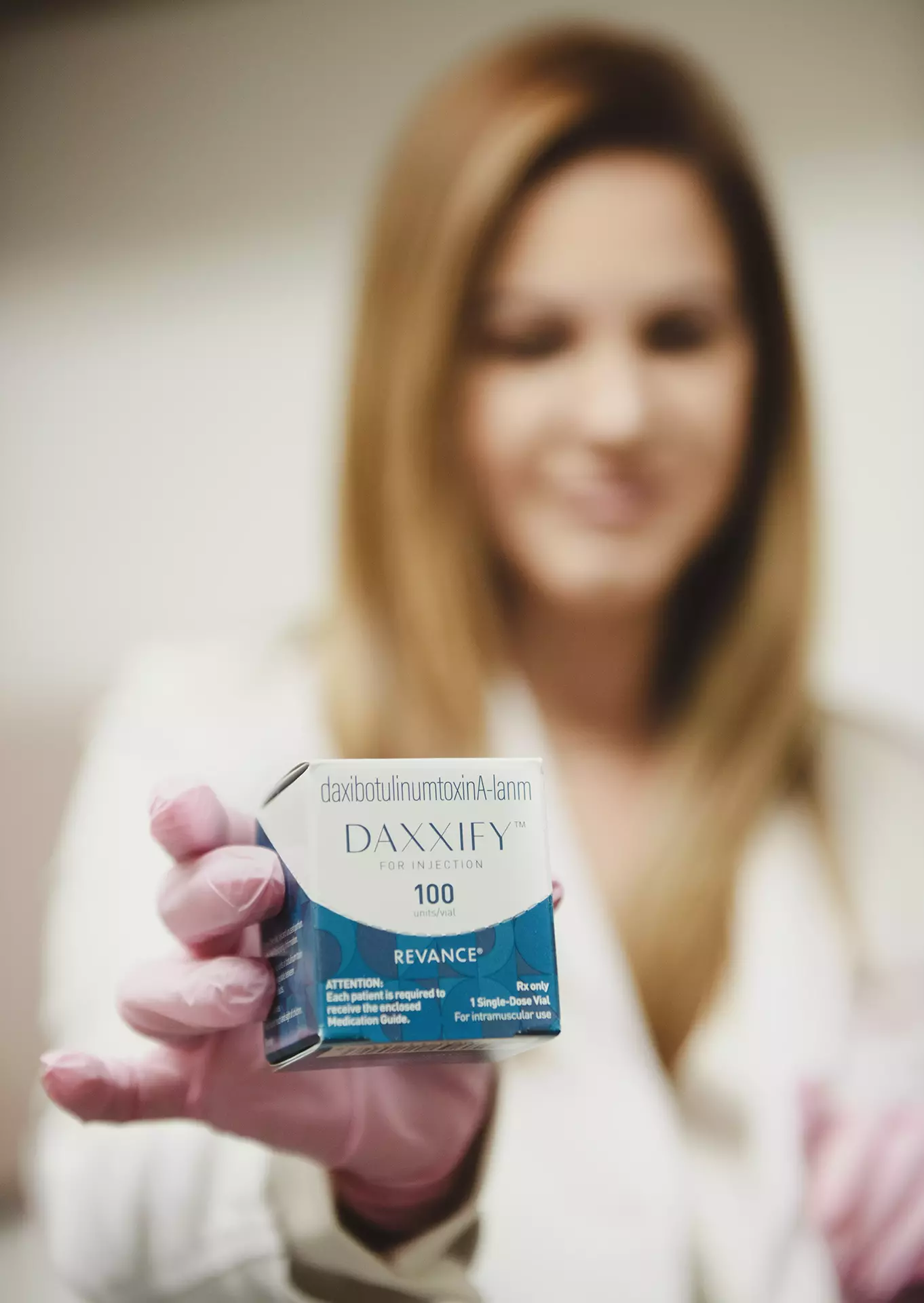
Daxxify (daxibotulinumtoxinA) was FDA-approved in 2022 for moderate-to-severe glabellar lines and is the newest serious entrant in the U.S. neuromodulator category. Its key technical difference is that it uses a proprietary peptide to stabilize the toxin instead of human serum albumin (the carrier protein found in Botox and Dysport). That formulation difference is what enables Daxxify’s headline benefit.
That benefit is duration: clinical trials and real-world data show Daxxify lasting 6 to 9 months — roughly double the duration of Botox. Onset is also fast, with many patients seeing softening within 1 to 2 days of injection. The trade-off is cost: per-unit pricing runs higher than Botox, and you generally need a comparable unit count, so a single Daxxify session is more expensive up front. The math often still favors Daxxify for the right patient because you may only need two sessions per year instead of three or four.
Daxxify is best for patients who hate the three-month appointment cycle, who have severe frown lines that don’t fully respond to standard Botox dosing, or who simply value fewer touch-ups over a lower per-visit price. It’s a great fit for executives, busy parents, and out-of-town patients who travel for treatment. Read our deeper Daxxify guide for a full breakdown.
Dysport — The Fast-Acting Alternative
Dysport (abobotulinumtoxinA) was FDA-approved for cosmetic use in 2009 and has built a loyal following among patients who’ve found Botox’s onset too slow. The toxin molecule is smaller than Botox’s, which translates to a faster onset — many patients see softening in 2 to 3 days rather than the 7 to 14 days typical of Botox.
Dysport also tends to spread slightly wider from the injection point. That property is a feature, not a bug, when treating broad expressive areas like the forehead or crow’s feet because fewer injection points can cover the same surface area smoothly. It’s less ideal when you need surgical precision — for example, a small dose to a single muscle band — because the spread pattern can affect adjacent muscles you didn’t intend to relax.
One critical thing to know: Dysport units are not equivalent to Botox units. Roughly 3 Dysport units equal 1 Botox unit, so per-unit pricing comparisons are meaningless. Dysport is best for patients who have an event coming up and need fast results, who have larger forehead surface areas to treat, or who tried Botox and felt the onset was simply too slow. For a head-to-head, see our Dysport vs Botox deep dive.
Xeomin — The “Naked” Neurotoxin
Xeomin (incobotulinumtoxinA) was FDA-approved in 2011 and stands apart from the other three products in one important way: it is pure botulinum toxin without the surrounding accessory proteins that come bundled with Botox and Dysport. This is why injectors sometimes call it the “naked” or “clean” toxin.
The theoretical advantage of fewer accessory proteins is a lower risk of antibody resistance over time. A small percentage of long-term neuromodulator patients eventually develop neutralizing antibodies that make their treatments work less well or wear off faster. For those patients, switching to Xeomin can sometimes restore the full response. Performance-wise, Xeomin is broadly comparable to Botox in onset (4 to 7 days) and duration (3 to 4 months).
Xeomin is best for patients with known sensitivities to additives, those who prefer the cleanest possible formulation, or anyone who has used Botox for many years and noticed it “not working as well” recently. Read our detailed Xeomin vs Botox comparison if you suspect resistance is an issue for you.

What About Letybo? (The New One)
Letybo (letibotulinumtoxinA) received FDA approval in February 2024 and is currently rolling out across U.S. clinics. It’s manufactured by Hugel, a Korean company that has been the dominant neuromodulator brand in South Korea for years. Early marketing positions it as offering a Botox-like profile at a more accessible price point.
Long-term clinical data in U.S. patient populations is still limited, and patient-reported experiences are still being collected. It’s a product worth watching, but for most patients in 2026 there’s no urgent reason to switch from a proven option to a newer one until more real-world data is available. We’ll continue evaluating it and will update this guide as it earns a place in our standard menu.
How to Choose: Decision Tree
If you’re trying to decide between products without going to a consultation first, this is a reasonable starting framework. Your injector will refine these recommendations based on your face.
- Want predictability above all? → Botox
- Want it to last 6+ months? → Daxxify
- Need it to work fast for an event? → Dysport
- Used Botox for years and noticing diminishing returns? → Xeomin
- First-time patient, no strong preference? → Botox or Dysport (your provider will guide you based on your anatomy)
- On a tight budget? → Cost varies more by units used than by product. Consult your injector before assuming one is cheaper than another.
Can You Switch Between Products?
Yes — and many patients do. It’s common to use Daxxify for big life events (weddings, vacations, holiday seasons) where you want the longest-lasting result, and then return to Botox for routine maintenance. Switching does not require a washout period and your face does not “remember” the previous product after it has fully worn off.
What matters far more than which product you switch to is who is injecting it. Provider technique, dosing accuracy, and anatomical knowledge make a much bigger difference in your final result than the brand on the vial. A good injector with Botox will outperform a mediocre injector with the most expensive Daxxify session of your life.
Treatment Areas That Work for All Four
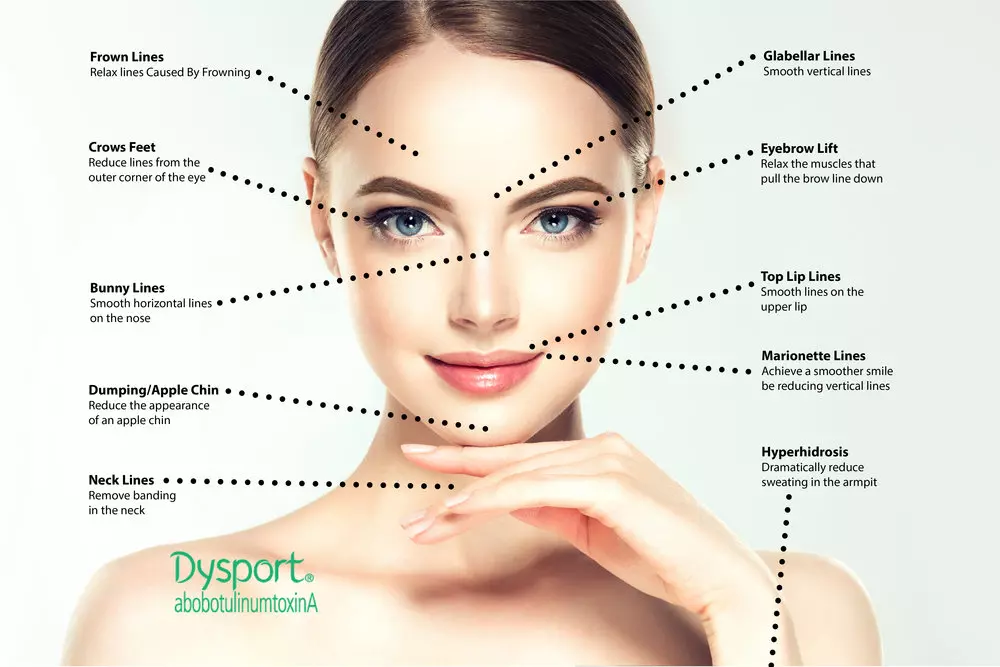
All four neuromodulators are used — sometimes on-label, sometimes off-label — for the same range of cosmetic and functional indications. Here is the typical menu:
- Forehead lines
- Glabellar (frown) lines between the brows
- Crow’s feet around the eyes
- Bunny lines (the diagonal lines on the nose)
- Lip lines (perioral wrinkles)
- DAO (depressor anguli oris — the muscle that pulls mouth corners down)
- Masseter (jaw slimming and TMJ relief)
- Platysmal bands of the neck
- Underarm and palmar hyperhidrosis (off-label cosmetic, on-label medical for excessive sweating)
For deeper reads on specific areas, see our guides on Masseter Botox, DAO Botox, and Botox for double chin.
Why Provider Experience Matters More Than Product Choice
The same product, in the hands of two different injectors, can produce wildly different results. The vial doesn’t know your anatomy — the person holding the syringe does. What separates a good outcome from a frozen, asymmetric, or short-lived one is dose calibration, injection-site selection, depth of placement, and the injector’s ability to read your facial muscle patterns at rest and in motion.
When you’re choosing a clinic, look for: clear medical credentials (PA-C, NP, RN under physician supervision, or physician), high injection volume in their daily practice, and before/after photos that match the kind of result you want, not just textbook outcomes. At Femme, our clinical team injects neuromodulators every single day and customizes the product to your anatomy and goals rather than defaulting to whatever’s on the shelf.