
If you are looking for the short answer: tell your clinician everything you take, including over-the-counter medicines and supplements, and let them decide what if anything should change. That single step matters more than every other item on every pre-treatment checklist combined.
The longer answer is the interesting one. Search "what to avoid before Botox" and you will find the same list on hundreds of clinic websites — no fish oil, no alcohol, no ibuprofen, no vitamin E, arrive caffeine-free — reproduced almost word for word and almost never with a citation. We went and checked. Some of those items trace directly to manufacturers' FDA labeling. Some trace to the American Academy of Dermatology. And some, when you look for a source, do not appear in any authoritative document at all.
We think you are better served knowing which is which.
The rule that overrides everything else
Do not stop a prescribed medication to prepare for a cosmetic appointment. Not a blood thinner, not an anti-platelet, not anything.
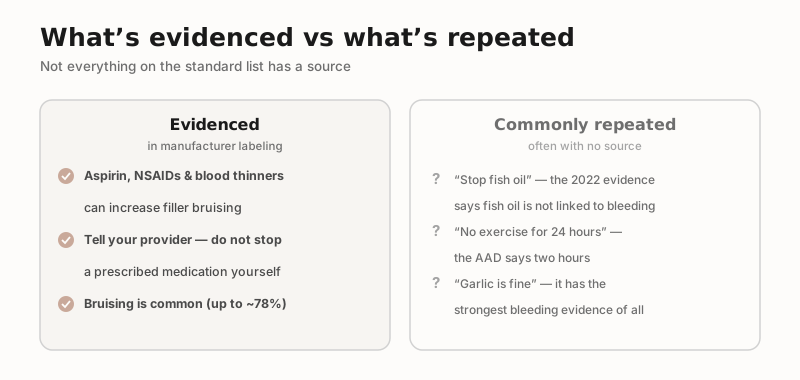
This is worth stating bluntly because the internet gets it backwards constantly. The manufacturer’s own patient labeling for hyaluronic acid filler does not say to stop anything. It says: "Tell your doctor before treatment if you are using substances that can prolong bleeding, such as aspirin, ibuprofen, or other blood thinners. As with any injection, this may result in increased bruising or bleeding at the injection site."
Tell. Not stop.
Those medicines are usually prescribed for reasons considerably more important than a bruise — stroke prevention, cardiac conditions, clotting disorders. The decision to pause one, if it is ever appropriate, belongs to the clinician who prescribed it, made with your full history in front of them. It does not belong to your injector, and it certainly does not belong to a web page. If your prescriber says no change, then the plan is that you may bruise more, and we work around that.
The professional labeling for the same filler family adds that it "should be used with caution in patients on immunosuppressive therapy," and that patients using aspirin, non-steroidal anti-inflammatory drugs or warfarin "may, as with any injection, experience increased bruising or bleeding." Again: information to bring to the appointment, not instructions to act on alone.
The countdown, honestly labelled
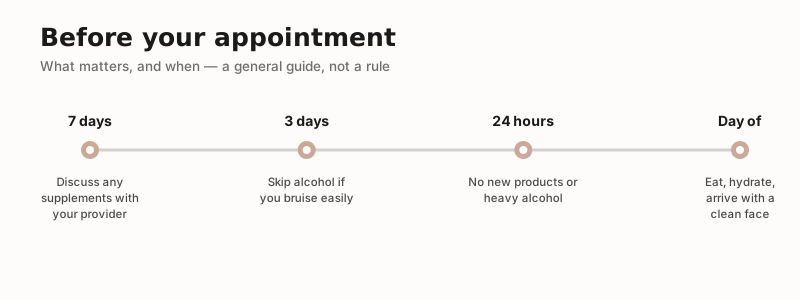
Here is a normal-looking preparation timeline. The difference is the last column, which tells you where each item actually comes from.
| When | What | Where it comes from |
|---|---|---|
| Whenever you book | Tell us every medicine you take, including ones bought without a prescription, plus all herbs, vitamins and minerals | AAD guidance |
| Whenever you book | Tell us if you are pregnant or planning to be | AAD guidance |
| Whenever you book | Tell us about every previous cosmetic treatment and surgery, including things you’d rather not mention | AAD guidance |
| 7 days | Discuss bleeding-risk medicines with the clinician who prescribed them — not with us, and not by stopping them | Filler labeling (the tell part); the 7-day framing is our convention |
| 7 days | Reschedule if you have an active skin infection or inflammation at the site | Filler labeling |
| 3 days | Common supplement advice — fish oil, omega-3, vitamin E, ginkgo | No authoritative source. See below |
| 24 hours | Common alcohol advice before treatment | No authoritative source before treatment. Labeling addresses alcohol after, not before |
| Day of | Arrive with clean skin, no makeup if convenient | Practical, ours |
| Day of | Eat something beforehand | Practical, ours |
| Day of | Don’t schedule it the day before an event you care about | Genuinely evidenced, see the timing section |
The AAD’s preparation guidance is specific about the disclosure part and worth quoting properly: "Be sure your dermatologist knows about all pain-relievers, blood thinners, and other medicines. Include medicines that you buy without a prescription, such as aspirin. All herbs, vitamins, and minerals you take. Even if you haven’t taken these for a while, be sure to mention them."
Notice what that instruction is. It is a disclosure requirement, not a cessation requirement. That distinction runs through this entire article.
Evidenced, guided, or just repeated
Sorting the standard checklist into three honest buckets:
In the manufacturer’s labeling. The bleeding-risk disclosure for hyaluronic acid filler is real, specific and traceable. So is the 24-hour post-treatment instruction: the Juvéderm Ultra XC instructions for use state that "within the first 24 hours, patients should avoid strenuous exercise, extensive sun or heat exposure, and alcoholic beverages," and Restylane Defyne carries near-identical language. That is manufacturer-sourced and we follow it.
From dermatology guidance rather than labeling. The AAD’s disclosure list above. Its post-treatment guidance for botulinum toxin, which asks patients not to rub or massage the injected areas and to "wait two hours before you engage in strenuous physical activity." Its post-filler guidance to wait until the next day to exercise, stay out of the sun, avoid tanning beds, and avoid touching the treated area for three days.
Repeated without a traceable source. This is the bucket nobody publishes. We searched the full text of the Botox Cosmetic prescribing information, three AAD botulinum toxin pages, the AAD fillers FAQ, Juvéderm Voluma patient and professional labeling, and the Juvéderm Ultra XC and Restylane instructions for use. Across all of them, the following appear zero times: fish oil, omega-3, ginkgo, arnica, caffeine, retinol. Vitamin E appears once, in a Restylane document, and not as a pre-treatment instruction.
That does not make the supplement advice wrong. It makes it unsourced, which is a different thing. Several of those substances have a plausible mechanism for affecting bleeding, and pausing an optional supplement carries essentially none of the risk that pausing a prescribed medication does. So we still ask about them — but we tell you it is a precaution rather than dressing it up as a rule handed down by a regulator. If a website tells you the FDA or the AAD says to stop fish oil before Botox, that website has not checked.
Where the sources genuinely disagree
One item deserves its own paragraph, because the honest answer is that experts differ.
The AAD’s public guidance says to wait two hours after botulinum toxin injections before strenuous physical activity, including lifting heavy items and anything that raises your heart rate. Cleveland Clinic publishes something close to the opposite: "Some healthcare providers say you should avoid physical activity for at least 24 hours after you’ve gotten injections, but Dr. Zins says there’s little evidence to show that physical activity affects how your Botox settles." Cleveland Clinic goes on to note a different reason to consider waiting — "Exercise can raise your blood pressure, which can increase bruising, so you may want to avoid it for a few hours if you tend to bruise."
Both are credible sources. They point in different directions. Our position is that the AAD’s two-hour interval is a low-cost precaution with a reputable source behind it, so we ask for it, while being straightforward that the evidence base is thinner than the confidence with which it usually gets stated. There is more on activity restrictions across different treatments in our forthcoming guide to exercising, swimming and flying after treatment.
If you bruise anyway
Bruising is not a treatment failure and it is not a sign something went wrong. It is far more common than the marketing suggests.
The clearest illustration comes from the manufacturer’s own clinical data. In the Juvéderm Voluma XC study of cheek augmentation, participants recorded symptoms in a 30-day diary. After initial treatment, bruising was reported by 78 out of 100 people, swelling by 86, and tenderness by 92. The labeling notes these effects "were usually moderate in severity, did not require treatment, and generally lasted 2 to 4 weeks," and were reported less often after repeat treatment.
Read that in context: it is one product, in the cheeks, at a median volume considerably larger than most single-syringe appointments, in a diary study that captured everything. Your appointment is probably not that appointment. But the direction is clear, and it is the opposite of what glossy before-and-afters imply. The AAD gives a shorter general window, describing post-filler redness, swelling, tenderness and occasional bruising as tending to clear within 7 to 14 days, and bruising after botulinum toxin as typically lasting about a week — caused, it notes, by the injections rather than by the product.
Call your clinician rather than waiting it out if you have significant pain away from the injection site, redness or visible swelling lasting more than a few days, any side effect appearing weeks or months later, or anything else that worries you. That list is taken directly from manufacturer patient labeling, and the last item is deliberately open-ended.
Timing, which matters more than any supplement
The single most effective thing you can do to avoid arriving at an event with a bruise has nothing to do with what you avoid. It is booking far enough ahead.
For neuromodulators, the prescribing information says the effect begins one to two days after injection and increases in intensity through the first week. You may have read that Botox "reaches full effect at 10 to 14 days." That interval does not appear anywhere in the Botox Cosmetic prescribing information — we searched the full label text and it is simply not there. Use the label’s own framing instead: it starts in a day or two and builds over the first week. The labeled duration of effect for glabellar lines is approximately 3–4 months.
For filler, most hyaluronic acid results are visible immediately, but swelling is not, and swelling is what makes people panic in week one.
Neither of those timelines is compatible with an appointment the day before a wedding. We have written separately about planning treatment around a fixed date.
Cost, briefly
Preparation does not change what treatment costs, but two things related to it can. Bruising or swelling that leads you to postpone a planned follow-up shifts your schedule and therefore your annual spend. And treatments differ in maintenance rhythm — a neuromodulator repeated at roughly 3–4 month intervals has a different annual shape from a filler lasting a year or more, even when a single appointment is comparable. We don’t list figures here; current pricing is on our pricing page, and a consultation is where a plan gets costed against your actual goals.
A South Florida note
Two things are genuinely different here. Heat and sun exposure appear explicitly in hyaluronic acid filler instructions for the first 24 hours, and in Miami that is a real constraint in a way it isn’t somewhere with a mild summer — an afternoon at the beach after a morning appointment is not a neutral choice. And if you are travelling, build the appointment into the front of the trip rather than the end of it. Nobody enjoys discovering a bruise in an airport bathroom.
Before you book
If you are still deciding between categories, start with our guide to telling Botox and filler apart. If you already know, the service pages for Botox and dermal fillers cover what each appointment involves.
When you book a consultation, bring your medication list. Not a summary from memory — the actual list, including the supplements you don’t think count.
This content is for educational purposes only and does not constitute medical advice. It is not a diagnosis and cannot substitute for an in-person evaluation. Individual results vary. All procedures carry potential risks and side effects. Never start, stop, or change a prescribed medication based on information you read online — including this page. Consult a qualified healthcare provider before undergoing any treatment or procedure.
Sources
- JUVÉDERM VOLUMA XC Patient Labeling and Professional Labeling (PMA P110033), U.S. FDA — https://www.accessdata.fda.gov/cdrh_docs/pdf11/P110033c.pdf
- JUVÉDERM Ultra XC Instructions for Use, U.S. FDA — https://www.accessdata.fda.gov/cdrh_docs/pdf5/P050047c.pdf
- American Academy of Dermatology, Botulinum toxin therapy: Preparation — https://www.aad.org/public/cosmetic/wrinkles/botulinum-toxin-preparation
- American Academy of Dermatology, Botulinum toxin therapy: FAQs — https://www.aad.org/public/cosmetic/wrinkles/botulinum-toxin-faqs
- American Academy of Dermatology, Fillers: FAQs — https://www.aad.org/public/cosmetic/wrinkles/fillers-faqs
- Cleveland Clinic, Botox Aftercare: The Dos and Don’ts — https://health.clevelandclinic.org/botox-aftercare
- BOTOX Cosmetic (onabotulinumtoxinA) Prescribing Information, via DailyMed — https://dailymed.nlm.nih.gov/dailymed/drugInfo.cfm?setid=485d9b71-6881-42c5-a620-a4360c7192ab
⚠️ Editor: verify the Juvéderm Ultra XC URL above before publication. The document was read from a local copy; the accession path has not been re-confirmed against accessdata.fda.gov this session. All other URLs were verified from saved source metadata.
Related articles
- Botox vs Filler: Which One Do You Actually Need? — A1, this batch
- Can I Exercise, Swim, Fly or Sit in the Sun After Treatment? — A3, this batch. Forward link placed in "Where the sources genuinely disagree." Replace the plain-text reference with a live link at publication.
- How Long Before a Wedding or Big Event Should You Get Treated? — A4, this batch. Forward link placed in the timing section. Replace with a live link at publication.