
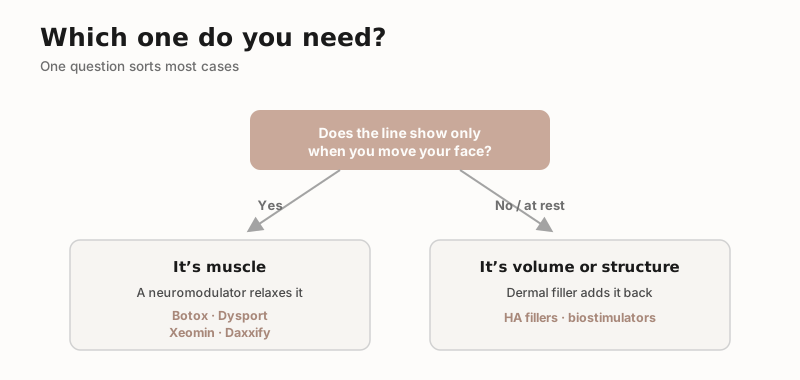
Here is the short version. If a line on your face appears when you move — when you frown, squint, or raise your eyebrows — and softens or vanishes when your face is still, that is a muscle doing it, and a neuromodulator like Botox is the category that addresses muscle movement. If the line or hollow is there when your face is completely relaxed, or if an area looks flatter and less supported than it used to, that is a volume and structure question, and that is what dermal filler is for.
One clarification before we go further, because the word travels strangely between languages. This article is about injectable botulinum toxin for facial lines. It is not about "botox capilar" or "hair botox," which is a salon smoothing treatment for hair that contains no botulinum toxin at all and has no relationship to anything described here. Same borrowed word, completely different thing.
The mirror test
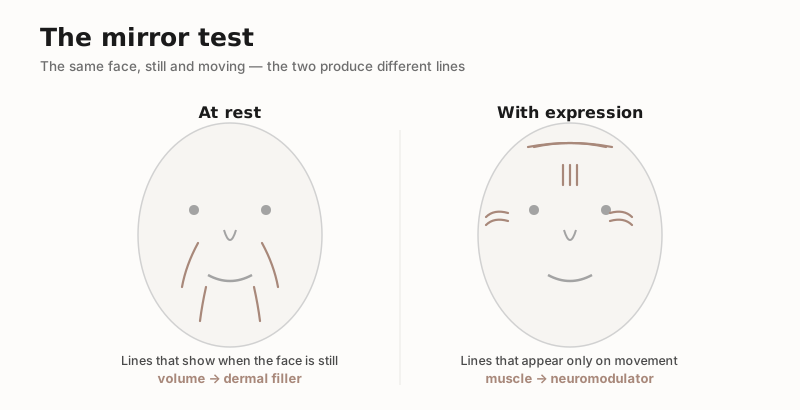
Stand in front of a mirror in decent light. Let your face go completely slack — no expression at all. Take note of what you see.
Now frown. Raise your eyebrows. Squint like you’re looking into the sun on Bird Road at 5pm.
Lines that showed up only in the second half of that exercise are dynamic — they are the surface consequence of a muscle contracting underneath. Lines and hollows that were already visible in the first half, when nothing was moving, are static. They persist because the tissue itself has changed: less volume, less support, less springiness in the skin.
Most faces have both. That is normal, and it is the reason so many consultations end with a plan that includes both categories rather than one. But knowing which of the two is bothering you most is the difference between walking into an appointment with a vague wish and walking in with a question your injector can actually answer.
What a neuromodulator actually does
Botox and its relatives are purified botulinum toxin type A, injected in very small amounts into specific muscles. The mechanism is well described: the toxin binds to nerve terminals and interrupts the release of acetylcholine, the chemical signal that tells a muscle to contract. The result is a temporary, reversible reduction in that muscle’s pull. As the American Academy of Dermatology puts it, the injection "temporarily relaxes the targeted muscles, causing fine lines and wrinkles to diminish."
Two numbers matter, and both come straight from the manufacturer’s FDA prescribing information rather than from clinic folklore.
Onset. The label states that the initial doses "induce chemical denervation of the injected muscles one to two days after injection, increasing in intensity during the first week." You may have read elsewhere that Botox "reaches its full effect at 10 to 14 days." That specific interval does not appear anywhere in the Botox Cosmetic prescribing information. It is a widely repeated convention, not a labeled fact, and we would rather give you the label’s language: something starts happening in the first day or two, and it builds through the first week.
Duration. For glabellar lines — the vertical "elevens" between the brows — the label gives a duration of effect of "approximately 3-4 months." The AAD independently describes the effect as lasting "about 3 to 4 months, and sometimes longer."
What this category does not do: it does not add anything. It does not fill a hollow, restore a flattened cheek, or build a chin. If your concern is that something is missing, relaxing a muscle will not put it back.
What filler actually does
Dermal fillers are injectable gels placed under the skin to add volume and structure where volume and structure have been lost. Most are hyaluronic acid, a sugar molecule your body already produces, formulated into gels of varying thickness for different jobs. Others use different materials entirely.
The practical differences between filler types come down to two things: how fast you see the result, and how long it lasts. The AAD publishes a straightforward summary of both.
| Filler material | When you see results | How long it typically lasts |
|---|---|---|
| Hyaluronic acid gel | Immediate | 4 to 12 months |
| Calcium hydroxylapatite (e.g. Radiesse) | Immediate | 6 months to 1 year |
| Poly-L-lactic acid (e.g. Sculptra) | 2 or 3 weeks | 1 to 3 years |
That third row is the one people are least prepared for. Sculptra is not really a filler in the fill-it-in sense — it works gradually and is intended to build over a series of sessions. If you want to look different by Saturday, it is the wrong tool, and any honest consultation will tell you so.
What this category does not do: it does not stop a muscle from moving. Filling a crease that is being folded into the skin by an active muscle several thousand times a day tends to be a losing argument with anatomy.
Side by side
| Neuromodulator (Botox, Dysport, Xeomin, Daxxify) | Dermal filler | |
|---|---|---|
| What it is | Purified botulinum toxin type A | Injectable gel (hyaluronic acid, calcium hydroxylapatite, poly-L-lactic acid) |
| What it addresses | Lines produced by muscle movement | Lost volume, lost structure, lines present at rest |
| Regulatory status | FDA-approved drug | FDA-approved device |
| Typical areas | Between the brows, forehead, crow’s feet | Cheeks, lips, chin, jawline, under-eye hollows, nasolabial folds |
| When you see it | Begins 1–2 days, builds through the first week | Immediate for most; 2–3 weeks for poly-L-lactic acid |
| How long | Approximately 3–4 months (glabellar lines) | 4 months to 3 years depending on material |
| Reversible? | No, but it wears off | HA fillers can often be reduced or dissolved with hyaluronidase (an off-label use); biostimulators and permanent materials cannot |
When the answer is both — and when it’s neither
A frown line that has been folded into the same spot for fifteen years often has a dynamic component and a static one: the muscle creates it, but the skin has also learned the crease. Treating the muscle stops it deepening; the etched line may need something else. This combination is ordinary, not a sales tactic, and a good injector will tell you which part they expect each thing to do.
It is also worth saying plainly that neither category is the answer to everything. Sun damage, uneven pigment, texture, laxity and crepiness are not muscle problems or volume problems, and no amount of either injectable will fix them. If what actually bothers you when you look in the mirror is tone and texture, injectables are the wrong aisle entirely, and a consultation should say so rather than sell you a syringe.
Who each one is not for
Both categories are medical procedures and both have people who should not have them.
Botulinum toxin products are not appropriate for people with an infection at the planned injection site, a known allergy to any component of the formulation, or certain neuromuscular conditions. The prescribing information also asks patients to tell their doctor about muscle relaxants, allergy or cold medicines, sleep medicines, antibiotics given by injection, and anti-platelet or anticoagulant medicines. It is not known whether botulinum toxin therapy can harm an unborn child, and the AAD instructs patients to disclose pregnancy or plans to become pregnant.
Filler is not appropriate where there is active infection or inflammation in the area. Hyaluronic acid filler labeling notes it should be used with caution in patients on immunosuppressive therapy, and that patients using substances that can prolong bleeding may experience more bruising.
Two things worth being firm about. First, none of that is a list for you to self-assess against — it exists so you know what to bring up. Second, where this is going to matter most for you, tell your clinician, and never stop a prescribed medication because a web page mentioned it.
The AAD is also unambiguous on where these should be done: never at a non-medical spa, a party, a salon, or someone’s home. Its guidance on fillers notes that when they are injected in a non-medical setting or by an inexperienced provider, "reports of more serious side effects increase dramatically."
Side effects and what’s normal
Both categories share a common set of short-lived, injection-related effects: redness, swelling, tenderness, and bruising. The AAD notes these tend to clear within 7 to 14 days after filler, and that bruising after botulinum toxin — which it attributes to the injections themselves rather than the product — typically lasts about a week.
More serious effects exist and are the reason provider choice matters. With filler, the ones that require immediate attention include significant pain away from the injection site, redness or visible swelling lasting more than a few days, or any new symptom appearing weeks or months later. Manufacturer patient labeling instructs patients to call their doctor if any of those occur, along with anything else that causes concern. That instruction is worth taking literally.
What drives the cost
We don’t publish per-syringe or per-unit figures here, because the honest answer is that it depends on things that can only be assessed in person. The variables that actually move the number are: which category you need, how many areas are being treated, the amount of product required for the result you want, which specific product is chosen, and how often you plan to maintain it. A neuromodulator at roughly 3–4 month intervals and a filler that lasts a year or more have very different annual shapes even when a single appointment costs something similar. Current figures live on our pricing page, and a consultation is where the plan gets costed properly.
A South Florida footnote
Two local realities are worth naming. Miami squints — the UV here is high year-round, and habitual squinting is a genuine driver of crow’s feet, which is a movement pattern rather than a volume problem. And swelling behaves differently in July than it does in a dry climate. If you have an event coming up, build in more runway than a national aftercare page suggests, and hold sun protection as a non-negotiable regardless of which category you choose.
Where to go from here
If the mirror test pointed toward movement, read more about Botox at Femme Aesthetics. If it pointed toward volume and structure, start with dermal fillers. If you genuinely can’t tell — which is extremely common, and not a failure of observation — that is precisely what a consultation is for.
Book a consultation with our team in South Miami, and bring the question rather than a conclusion.
Related reading: what to do — and skip — in the days beforehand, in What to Avoid Before Botox and Filler; and if you have a date on the calendar, how far ahead to book before a wedding or event.
This content is for educational purposes only and does not constitute medical advice. It is not a diagnosis and cannot substitute for an in-person evaluation. Individual results vary. All procedures carry potential risks and side effects. Consult a qualified healthcare provider before undergoing any treatment or procedure, and never start, stop, or change a prescribed medication based on information you read online.
Sources
- American Academy of Dermatology, Botulinum toxin therapy: FAQs — https://www.aad.org/public/cosmetic/wrinkles/botulinum-toxin-faqs
- American Academy of Dermatology, Botulinum toxin therapy: Preparation — https://www.aad.org/public/cosmetic/wrinkles/botulinum-toxin-preparation
- American Academy of Dermatology, Fillers: FAQs — https://www.aad.org/public/cosmetic/wrinkles/fillers-faqs
- BOTOX Cosmetic (onabotulinumtoxinA) Prescribing Information, via DailyMed — https://dailymed.nlm.nih.gov/dailymed/drugInfo.cfm?setid=485d9b71-6881-42c5-a620-a4360c7192ab
- JUVÉDERM VOLUMA XC Patient Labeling (PMA P110033), U.S. FDA — https://www.accessdata.fda.gov/cdrh_docs/pdf11/P110033c.pdf
Related articles
- What to Avoid Before Botox and Filler (and What Actually Matters) — A2, this batch
- How Long Before a Wedding or Big Event Should You Get Treated? — A4, this batch
- Xeomin vs Botox — existing page at
/xeomin-vs-botox/, for readers who have already narrowed to a neuromodulator - Chin Fillers — existing page at
/chin-fillers/, for readers whose answer was structure