These four names show up on the same shortlist constantly, as though they were competing versions of one treatment. They aren’t. They use three genuinely different physical mechanisms, they reach depth by different routes, and — a detail almost nobody explains — they don’t all sit in the same FDA device category.
Worth saying up front: we operate Morpheus8 and not the others. Every device comparison you’ll read online was written by someone in that position, which is why you should read this one for the mechanisms and the regulatory record rather than for a verdict.
Three ways to heat tissue
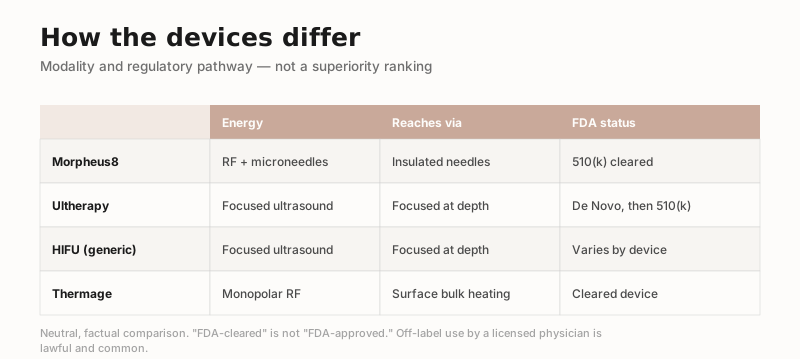
Radiofrequency microneedling — Morpheus8
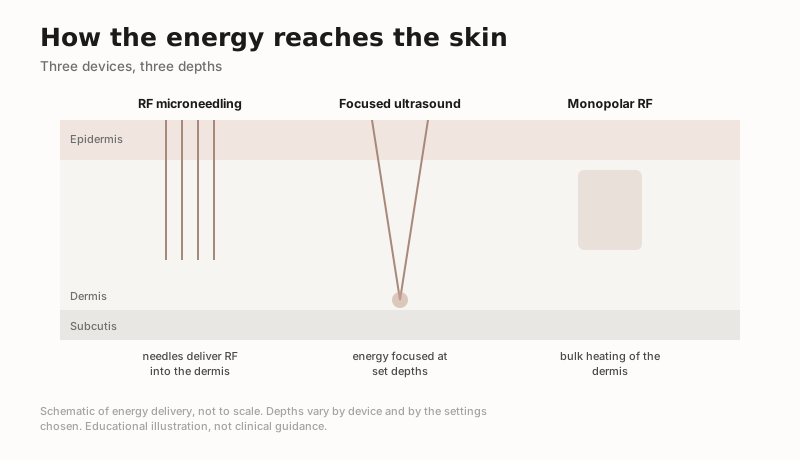
Morpheus8 drives an array of fine needles into the skin and delivers bipolar radiofrequency from their tips — a platform that, per the operator manual, "employs bi-polar Radio-frequency (RF) technology for use in dermatologic and general surgical procedures for electrocoagulation and hemostasis."
The distinguishing feature is that depth is set mechanically: selectable depths run 1–4 mm on the 12-pin tip, 1–7 mm on the 24-pin, 2–7 mm on the 40-pin body tip. Energy lands where the needle ends, rather than being projected through intact skin. The trade is a puncture wound, and therefore recovery.
Focused ultrasound — Ultherapy and HIFU
Ultherapy uses focused ultrasound. FDA’s device classification names the category precisely: "Focused Ultrasound For Tissue Heat Or Mechanical Cellular Disruption."
It converges acoustic energy at a point below the surface — the principle of a magnifying glass concentrating sunlight — leaving the surface intact. "HIFU" is the generic term; Ultherapy is one branded system within it, and HIFU devices are not equivalent to one another simply because they share an acronym. If someone offers you "HIFU," which device and what authorisation are fair questions.
Monopolar radiofrequency — Thermage
Thermage delivers monopolar radiofrequency through a handpiece on the skin’s surface, typically with surface cooling to protect the epidermis while heat builds underneath. No needles, no focal point — energy distributes by bulk heating rather than being deposited at a set depth.
So: needles place energy at a chosen depth, focused ultrasound converges it at a point, monopolar RF heats through volume. Three different problems in physics, and unsurprisingly three different experiences.
What "FDA cleared" actually means
Most aesthetic energy devices reach the US market through 510(k) clearance. The FDA’s clearance letter for the Morpheus8 applicators states the standard: the device was found "substantially equivalent (for the indications for use stated in the enclosure) to legally marketed predicate devices."
Read that again. Substantially equivalent — to something already on the market. A 510(k) is a finding that a new device is close enough to an existing one to be regulated the same way. It is not a finding that the device produces a particular cosmetic result. That’s a different and much heavier process, premarket approval, and these devices don’t go through it. Cleared and approved are not synonyms.
The specific case: the 2019 clearance for the Morpheus8 applicators (K192695) states the indication verbatim as —
"The InMode System with the Morpheus8 (Fractora) Applicators is intended for use in Dermatologic and General Surgical procedures for Electrocoagulation and Hemostasis."
Electrocoagulation and hemostasis. A programmatic search of that document returns zero occurrences of "wrinkle," "tighten," "collagen" or "rejuvenate." A later clearance for a different applicator (K240017, 2024) uses broader language — "coagulation/contraction of soft tissue or hemostasis" — which is closer to what patients have in mind, but still not a cosmetic efficacy finding.
None of this means anything improper is happening. A licensed physician using a cleared device beyond its labeled indication is ordinary, lawful medical practice. We’re not making a legal argument and not suggesting any clinic is doing anything wrong.
The point is narrower and more useful: the clearance is not the evidence. If someone tells you a device is "FDA cleared for skin tightening," ask what the clearance actually says, then ask separately what the clinical evidence shows. Marketing tends to merge those two questions.
The regulatory table nobody publishes
Here is where it gets genuinely interesting. From FDA’s device database:
| Device | Product code | Regulation | FDA classification name | Route to market |
|---|---|---|---|---|
| Morpheus8 (K192695, K240017) | GEI | 21 CFR 878.4400 | Electrosurgical, Cutting & Coagulation & Accessories | 510(k) |
| Thermage / Thermage FLX (K033942, K170758) | GEI | 21 CFR 878.4400 | Electrosurgical, Cutting & Coagulation & Accessories | 510(k) |
| Ultherapy (DEN080006, then K132028, K260618) | OHV | 21 CFR 878.4590 | Focused Ultrasound For Tissue Heat Or Mechanical Cellular Disruption | De Novo in 2009, 510(k)s since |
Two things stand out. Morpheus8 and Thermage sit in the same regulatory category — electrosurgical cutting and coagulation — despite being marketed as entirely different treatments. All three are Class II. And Ultherapy took a different route in: a De Novo is used when there’s no suitable predicate, which is how a new device category gets created. Ultherapy’s 2009 De Novo established the focused-ultrasound classification it has used since.
Neither category name mentions wrinkles, laxity or collagen — classification describes what a machine does physically, not what a patient hopes it will achieve.
What each device is actually cleared to claim is worth having in one place, because it varies more than the shared "skin tightening" marketing suggests. Ultherapy (the Ulthera System) is cleared — through its 2009 De Novo and later 510(k)s — for specific cosmetic indications: to lift the eyebrow, to lift lax submental (under-chin) and neck tissue, and to improve lines and wrinkles of the décolleté — with its 2026 clearance (K260618) adding the appearance of skin laxity on the abdomen, arms and knees. Thermage’s clearances cover non-invasive treatment of wrinkles and rhytids, with the original ThermaCool naming periorbital wrinkles specifically. Morpheus8, by contrast, is cleared for electrocoagulation, contraction of soft tissue and hemostasis — not for any named cosmetic outcome. So of the three, two carry cleared aesthetic indications and one does not, which is close to the opposite of how they are marketed as interchangeable.
One further item belongs here rather than buried in a footnote, because it concerns this device category directly. On 15 October 2025 the FDA issued a safety communication on radiofrequency microneedling, stating it is aware of reports of serious complications from these devices when used for dermatologic and aesthetic skin procedures — naming burns, scarring, fat loss, disfigurement and nerve damage, and the need for surgical repair or medical intervention. The FDA’s evaluation is ongoing and it is asking patients and providers to report complications. It also makes the point we would make: RF microneedling is a medical procedure, not a cosmetic one, and who holds the handpiece matters. We use this device, and this is the least convenient paragraph on the page — which is precisely why it is on it.
Downtime: the manufacturer’s numbers, not the marketing ones
Clinic blogs tend to quote friendlier recovery figures than the manufacturer does. InMode’s Morpheus8 operator manual states:
- "Typical down time is 1 to 6 days and depends on used energy and treatment depth."
- "Erythema lasting not longer than 24h and edema for 1-3 weeks is a typical skin reaction to the treatment."
- "Crusting from the ablated dots will exfoliate naturally after 1-3 weeks."
- "Make-up may be applied only 24-72 hours after each treatment session."
- "The patient should use a high-factor sunscreen (at least 30 SPF) and protect the treated area from over-exposure to sunlight for at least one month after the treatment."
Edema and crusting for up to three weeks are less convenient than "a few days of redness" — and they are what the company that built the device puts in writing. Swelling outlasting the visible redness is expected, not a sign something went wrong.
On sessions: "may vary from 1-5 sessions. Treatments are typically repeated every 3-6 weeks" (elsewhere the manual says 1 to 6). Since remodelling runs over months, a course of three takes a couple of months before you’ve even finished treating. If you have a fixed date, count backwards generously.
The other devices don’t puncture skin, so their recovery is generally described as shorter — mechanism-based reasoning rather than something we can source, so ask any provider for their own written aftercare.
Skin tone — the section that matters most in Miami
If you have a medium or deep skin tone, this outranks everything above.
Radiofrequency has a genuine advantage here: unlike light-based devices, RF is not absorbed preferentially by melanin, so skin pigment is less of a confounder. That’s why RF is often preferred for pigmented skin. But it isn’t unconditional, and the manufacturer’s documentation says so.
This is not a new caveat. The same energy-linked limit — "At higher energy levels greater than 62 mJ/pin, the use of the Morpheus8 ... Applicator is limited to Skin Types I-IV" — is written into the cleared indication of both the 2019 clearance (K192695, the Fractora applicator) and the 2024 one (K240017, the 90 applicator). A skin-type limit has been embedded in the authorised indication at higher energies from the start, not added later.
The operator manual reinforces it, listing among its cautions "Skin type V and dark VI patients treat with caution" and directing the operator to determine the patient’s Fitzpatrick type accurately. For skin types IV–VI it also describes a mitigation: a pre-treatment bleaching protocol, begun in the weeks before treatment and stopped shortly beforehand, intended to reduce the risk of post-inflammatory hyperpigmentation.
Post-inflammatory hyperpigmentation is the risk being managed — a real consideration in a patient population like ours. Any provider who tells you skin tone simply isn’t a factor with RF has not read the manual. The right questions: what Fitzpatrick type am I, what energy setting are you planning, and what’s your protocol for reducing pigmentation risk in my skin?
Where Morpheus8 is not the answer
This is the section competitor comparisons omit, so we’ll be specific.
If the problem is lost volume, not loose surface. A flat midface or hollow temple is a structural deficit, and heating skin doesn’t replace missing volume. That’s a filler or biostimulator conversation — see Sculptra.
If the problem is colour, not texture. Brown patches, redness and sun damage are pigment and vascular problems; RF doesn’t target chromophores. See intense pulsed light.
If the laxity is significant. There is a point past which no non-surgical energy device is the honest answer. If a consultation never mentions that threshold, that’s a signal about the consultation. Our page on addressing sagging skin covers the range.
If you can’t manage the recovery or the sun protection. A month of committed sun protection, in this city, is a real ask.
If you have a deep skin tone and the provider hasn’t raised it. That conversation should start with them, not with you.
What the comparative evidence actually shows
Honestly: less than anyone’s marketing implies. In the sources reviewed for this article we could not identify head-to-head trials that would justify saying any one of these devices outperforms another for a given concern. What exists is largely single-device studies with varying methods, endpoints and populations, which cannot validly be stacked against each other.
So we’re not going to tell you Morpheus8 beats Ultherapy, or the reverse. Which modality suits your skin, your tolerance for downtime and your actual concern is a clinical judgement made in person. Anyone offering certainty about relative superiority is selling ahead of the evidence.
Candidacy, preparation and aftercare
Reasonable candidate. Mild to moderate laxity or texture concerns, realistic expectations, able to complete a series and protect the treated area from sun for at least a month afterward.
Discuss carefully first. Deeper skin tones, for the reasons above. Active skin infection. A history of keloid scarring. Pregnancy. Any implanted electronic device. Recent isotretinoin — the manual cautions against "use of Isotretinoin (Accutane®) within 6 months prior to treatment" — and recent tanning, flagged as "irritable skin like excessively tanned skin from sun, tanning beds or tanning creams and sprays within the last two weeks."
Aftercare, per the manual: keep the area clean for two days; let crusting flake off rather than picking it; moisturiser and makeup only after 24–72 hours; no scrubs or exfoliants; SPF 30 or higher for at least a month; antiviral prophylaxis continued if you have a cold sore history and the mouth area is treated.
Side effects, per the manual: "discomfort or pain, excessive skin redness (erythema) and/or swelling (edema), damage to natural skin texture (crust, blister, and burn), change of pigmentation (hyper- and hypo-pigmentation), and scarring." Those are the manufacturer’s words, and they are the reason operator skill and correct settings matter more than the brand on the machine.
Cost factors
No prices here. What drives the number: area size and how many areas; depth and energy settings, which affect time and consumables; the number of sessions; whether topical anaesthetic is used; and whether it’s combined with anything else. Current pricing lives on the pricing page.
The cross-device warning: comparing a per-session Morpheus8 quote against a per-session Ultherapy quote is close to meaningless, because they aren’t the same intervention, session counts differ, and recovery costs you time as well as money.
Miami relevance
The manual’s instruction to use SPF 30+ and protect the treated area for at least a month is not a small commitment here. NOAA Climate Prediction Center data records zero clear-sky low-UV days in Miami in either 2025 or 2024; in 2025, 146 days fell in the extreme category. The EPA classifies UV 8 and above as "Very High to Extreme — Extra protection needed."
The manual also bars tanning of any kind in the treated area "during the entire course of the treatment," which for a three-session course means several months. Combine that with the pigmentation caution for skin types IV and above, and timing and aftercare discipline genuinely affect the outcome here, not just the comfort.
Next step
If you’re cross-shopping devices, stop comparing brand names and start describing the problem: is it loose skin, lost volume, uneven colour, or texture? Different answers point to different categories, and some aren’t energy devices at all.
Read about Morpheus8 at our practice, or book a consultation in South Miami and bring your questions about the other devices. We’d rather tell you something else is a better fit.
Related reading: if the change you’re seeing is really about hormones and skin, start with Perimenopause and Your Skin; and if you have an event coming up, how far ahead to plan energy treatments.
Sources
- FDA 510(k) K192695, InMode System with the Morpheus8 (Fractora) Applicators, cleared 27 December 2019 — https://www.accessdata.fda.gov/cdrh_docs/pdf19/K192695.pdf
- FDA 510(k) K240017, InMode System with the Morpheus8 90 Applicator, cleared 13 June 2024 — https://www.accessdata.fda.gov/cdrh_docs/pdf24/K240017.pdf
- FDA De Novo DEN080006 (2009) and 510(k)s K132028 (2013) and K260618 (2026), Ulthera System; Thermage 510(k)s K033942 (2004) and K170758 (2017) — FDA 510(k) database, https://www.accessdata.fda.gov/scripts/cdrh/cfdocs/cfPMN/pmn.cfm
- FDA Product Classification database: product code GEI, 21 CFR 878.4400 (Electrosurgical, Cutting & Coagulation & Accessories) and product code OHV, 21 CFR 878.4590 (Focused Ultrasound For Tissue Heat Or Mechanical Cellular Disruption) — https://www.accessdata.fda.gov/scripts/cdrh/cfdocs/cfPCD/classification.cfm
- US Food and Drug Administration, Potential Risks with Certain Uses of Radiofrequency (RF) Microneedling — FDA Safety Communication, 15 October 2025 — https://www.fda.gov/medical-devices/safety-communications/potential-risks-certain-uses-radiofrequency-rf-microneedling-fda-safety-communication
- InMode, Morpheus8 operator manual — source of the quoted downtime, session, caution, aftercare and side-effect statements.
- NOAA Climate Prediction Center, Daily UV Index annual time series, Miami FL, 2024 and 2025 — https://www.cpc.ncep.noaa.gov/products/stratosphere/uv_index/uv_annual.shtml
- US Environmental Protection Agency, UV Index Scale — https://www.epa.gov/sunsafety/uv-index-scale-0
Educational disclaimer
This content is for information only. It is not medical advice, diagnosis or treatment, and it does not create a provider-patient relationship. It is not a regulatory or legal opinion. Descriptions of FDA clearance status reflect publicly available FDA records as reviewed on the date noted in the internal record and may change. Energy-based skin treatments carry real risks including burns, pigment change and scarring. Candidacy and settings can only be determined by a licensed professional at an in-person evaluation. Results vary and no outcome is guaranteed.
Related articles
- Morpheus8 — the treatment at our practice
- FDA safety communication on RF microneedling — the safety notice, at the source
- Addressing Sagging Skin — the full range of options
- Sculptra — when the problem is volume, not laxity
- Intense Pulsed Light — when the problem is colour, not texture