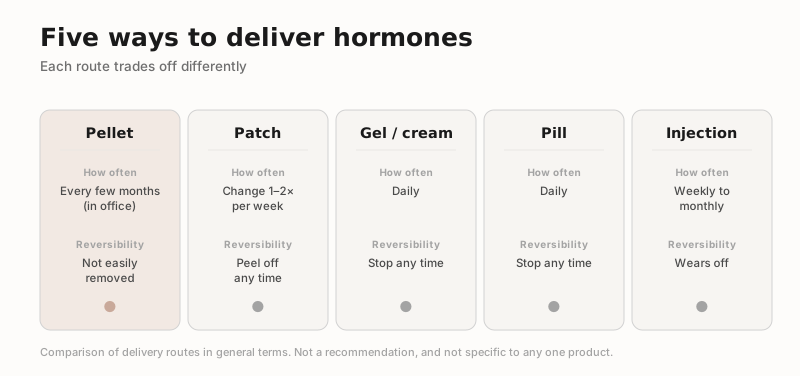
There is no delivery method that is best for everyone, and any page that tells you otherwise is selling one. What actually differs between a pill, a patch, a cream, an injection and a pellet is physical: how often you have to do something, how much of the decision is yours day to day, and — the part most comparisons skip — how easily you can stop once you have started.
We use pellets. That is a reason to read this critically, and a reason we have tried to write it so you can.
Start with the regulatory picture, because it changes how you should read everything else
Compounded hormone pellets are not FDA-approved.
That sentence is on this page because you deserve to encounter it here rather than three months into treatment. It is also frequently weaponised in both directions, so here is the other half: the FDA has not banned or restricted compounded hormone pellets either.
Both of the loud positions overstate the evidence. "Proven safe" is not supported. "Proven dangerous" is not supported. What is accurate is narrower and less satisfying: this is a category the FDA has not approved and has not prohibited, and it therefore has not been through the specific premarket evidence review an FDA-approved product has been through.
You will not find regulatory-approval language of any kind attached to a compounded pellet anywhere on this site. If you find it attached to one somewhere else, that is a meaningful signal about the source.
Some hormone products delivered by other routes — certain patches, pills, gels and vaginal preparations — are FDA-approved. That is a real difference between the categories and you should weigh it. It is not, by itself, the whole decision, and anyone presenting it as the whole decision is skipping the parts where the routes actually differ for you.
There is recent regulatory movement worth knowing, and it concerns the FDA-approved products, not the compounded ones. In November 2025 the FDA asked manufacturers of approved menopausal hormone therapies to revise their labeling, and on 12 February 2026 it approved the first changes for six products (systemic and topical vaginal): the boxed-warning language about cardiovascular disease, breast cancer and probable dementia was removed. The information itself was relocated, not deleted — for systemic products the cardiovascular and breast-cancer detail stays in the body of the label, and the endometrial-cancer boxed warning is kept for systemic estrogen-alone products. The agency’s stated reasoning was that those warnings — drawn largely from a trial population averaging 63 years old — had been deterring younger women in early menopause, for whom the benefit-risk balance is different. Note what this does and does not mean: it applies to FDA-approved products, and it does not make compounded pellets approved, better studied, or safer. If anything it sharpens the contrast — the approved products are the ones whose labeling the FDA actively maintains.
The main routes, and what genuinely separates them
We are keeping this to what can be described honestly: the physical form, how often it requires action from you, and what happens if you want to stop. We are deliberately not giving you absorption curves, blood-level graphs or "steady state" claims. More on why below.
Pills
Taken by mouth, typically daily. The most familiar format, the easiest to obtain, and the easiest to stop — you stop taking it. The daily requirement is the honest downside: a treatment you take every morning is a treatment you can forget every morning, and adherence over months and years is a real clinical variable, not a character flaw.
Patches
Applied to the skin and replaced on a set schedule — typically once or twice a week, depending on the product. Less frequent than a pill, still your responsibility, and reversible in the most literal way available: you take it off.
The practical questions with a patch are physical. It has to stay on. Heat, humidity, swimming, sweat and skin sensitivity at the application site are all things patients raise, and in South Florida they are worth raising before you choose rather than after — a question for your consultation, not something an article can answer for your skin.
Creams and gels
Applied topically, usually daily, sometimes more than once. Dose adjustment is comparatively granular. Stopping is straightforward.
Two things are worth knowing in advance: application has to be consistent to be meaningful, and topical hormone products carry transfer considerations — contact with a partner, a child or a pet at the application site. Ask specifically about this. It is the most commonly under-explained aspect of the topical route.
Vaginal (local)
Worth naming separately because it answers a different question. Low-dose vaginal estrogen — creams, tablets or rings — is aimed at local genitourinary symptoms of menopause (vaginal dryness, discomfort, urinary changes), with comparatively little absorbed into the rest of the body. It is not a systemic substitute for the other routes and is not what a pellet is competing with; it is a targeted tool for a specific set of symptoms. FDA-approved products exist, and the November 2025 labeling review specifically condensed the warnings on the local vaginal formulations. If your main concern is vaginal or urinary rather than whole-body symptoms, this is the conversation to have — a different one from the pellet-versus-patch question.
Injections
Given at set intervals rather than daily, removing the daily decision entirely. Once a dose has been given, it has been given — you cannot un-inject it, though the interval is short enough that the practical horizon is weeks rather than months. Requires a visit or self-administration, and for some people the needle itself is the deciding factor. That is a legitimate reason to choose differently and does not need to be argued out of you.
Pellets
A small pellet is placed under the skin during a short in-office procedure and stays there for months rather than days. Nothing is required of you between placements — no daily application, nothing to remember, nothing to keep on your skin in the heat.
That is the genuine appeal, and it is not a small one: adherence stops being a variable, because there is nothing to adhere to. It also comes with the trade-off the rest of this article is built around.
The trade-off pellet pages leave out
A pellet cannot easily be removed once it has been placed.
That is the single most important practical difference between a pellet and every other route on this page, and it deserves stating plainly rather than burying under a benefits list.
If a pill does not suit you, you stop taking it. A patch, you peel off. A cream, you stop applying. A reaction, a change of mind, a new diagnosis, a pregnancy, a surgery — with the other four routes the decision is reversible on a timescale of hours to days.
With a pellet, it is not. It is under your skin, continuing to do what it does for the duration it was designed for.
This is not a reason to rule out pellets. It is a reason to be more certain before you start than you would need to be with a cream, and a reason to ask directly — at consultation, before anything is placed — what the plan is if it does not agree with you. If a clinic cannot answer that comfortably, that tells you something.
We would rather you knew this from us.
Comparison table
| Pills | Patches | Creams / gels | Injections | Pellets | |
|---|---|---|---|---|---|
| Physical form | Swallowed | Adhesive worn on skin | Applied to skin | Injected | Placed under the skin |
| How often you act | Usually daily | Usually weekly or twice-weekly | Usually daily | At set intervals | Only at placement, months apart |
| Adherence burden | Highest — a daily decision | Moderate | High — daily and technique-dependent | Low between doses | Lowest — nothing between placements |
| Can you stop it yourself? | Yes, immediately | Yes, immediately | Yes, immediately | Not the dose already given | No — not easily |
| Practical reversibility | Hours to days | Hours to days | Hours to days | Weeks | Months, and not by you |
| Everyday friction | Remembering | Adhesion, heat, humidity, skin irritation | Consistency, transfer to others | Needles, visits or self-injection | An in-office procedure and a recovery site |
| FDA-approved products exist in this category? | Yes, for some products | Yes, for some products | Yes, for some products | Yes, for some products | Compounded pellets: no |
This table compares delivery routes generically. It is not a comparison of specific products, brands or formulations, and it makes no claim about what any particular clinic compounds, sources or dispenses.
The claim we are not going to make
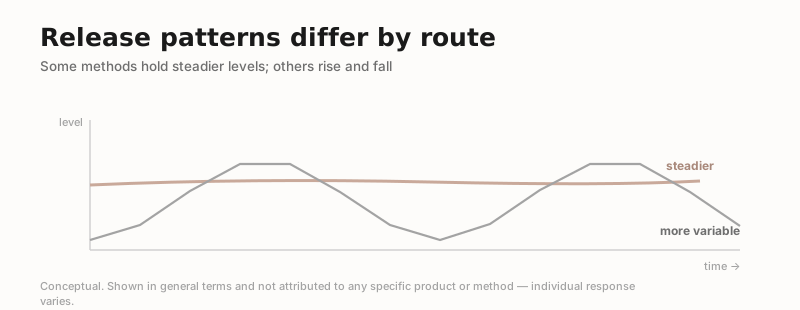
The argument on nearly every pellet page — including, historically, pages like ours — is that pellets deliver a steadier hormone level than a daily cream or a weekly patch, avoiding "peaks and valleys."
Steady delivery is the design intent of anything implanted rather than reapplied. That much is what the format is for.
But we are not going to hand you a graph, a percentage, or a claim of demonstrated superiority, because we cannot point you to the head-to-head evidence that would justify it. Be sceptical of any clinic that gives you a number here — including us, if we ever do. The design rationale is real. Proof of superior outcomes is a different and much stronger claim, and not one this article will make.
There is a further wrinkle worth being honest about. Where the pharmacokinetics of hormone pellets have actually been measured, "steady" is not the word that fits. The National Academies' 2020 review of compounded hormone therapy found testosterone-pellet blood levels that were both highly variable from person to person and supraphysiologic — above the normal reference range for women — for a period after insertion. So the marketing has it backwards: the honest concern with a pellet is not that it smooths out peaks, but that a level, once it is set under your skin, cannot easily be dialed back down. That is the reversibility problem from a different angle.
A less impressive paragraph than the one our competitors run. Also the one you can trust.
What the delivery method does not change
This reframes the whole comparison, and is worth sitting with before you spend much energy on the route question.
It does not change what menopause does to your body composition. In the SWAN cohort, using DXA scanning, the rate of fat gain doubled at the start of the menopause transition and lean mass declined — and yet weight itself "climbed linearly during premenopause without acceleration" at the transition, with the authors stating there is "no discernable change in rate of weight gain" at its start. More fat, less muscle, at a similar number on the scale. That is the actual phenomenon, and no delivery route changes what it is.
It does not change what the evidence on hormones and skin supports. Estrogen treatment in postmenopausal women "has been repeatedly shown to increase collagen content, dermal thickness and elasticity," and a 1987 study found the postmenopausal decline in skin collagen "was preventable in women who were on sex hormone replacement therapy." That 1987 study, it is worth noting, used implants rather than a modern formulation — which is interesting given the subject of this article, and still not a basis for claiming pellets are proven for skin. Meanwhile, from the same review that supports the collagen finding: results on elastin content, sebaceous secretions, wrinkling and blood flow are discordant. The studies disagree. That is true whichever route you choose.
If skin is the reason you are here, we have written that up properly, including the parts that do not favour us.
It does not change whether hormone therapy is appropriate for you. Candidacy, risks, monitoring and your medical history dominate that question. Delivery route is a downstream decision. Choosing the format first and working backwards is the wrong order, and it is a surprisingly common one.
How the choice actually gets made
Not by a table. By a conversation, usually around a few practical axes:
How much daily management do you want? Some people find a daily routine reassuring and want the control. Others know themselves well enough to know a daily anything will not survive month four. Both answers are valid and point to different routes.
How much do you want to be able to change your mind? If you are early, uncertain, between diagnoses, or have had a difficult experience with a medication before, the reversible routes are worth taking seriously — specifically because they are reversible.
What does your life physically look like? Daily swimming, heavy heat exposure, shift work, frequent travel, small children at home. In Miami, heat and water are not edge cases.
What has already happened to you? Prior response to hormone therapy, side effects you have had, and your full medical history matter more than any of the above, and they need someone looking at your labs rather than a comparison table.
That last one is why we do not publish a decision tree. A decision tree here would be a marketing asset pretending to be clinical judgement.
What to expect, and on what timeline
Whatever route is arrived at, the structure is broadly similar: assessment and history, lab work, a plan, and follow-up monitoring — the monitoring being the part that matters most and gets discussed least. Hormone therapy is not a purchase. It is an ongoing relationship with lab work in it.
Pellets specifically involve a short in-office procedure and a healing site, with soreness afterwards and some activity restrictions in the days following. The particulars belong to your consultation.
We are not putting a "results by week X" figure in this article. Timelines depend on what is being treated, at what dose, in whom — and quoting a number without those variables is exactly the kind of claim this article exists to avoid.
If you are trying to work out whether the conversation is worth having at all, the signs that may point toward hormone therapy is a better starting point than this page.
Side effects and safety
Every route carries risk, and the risks that matter most belong to hormone therapy itself rather than to the format it arrives in. Those are a consultation topic with your history in front of the person advising you — not an article topic, and not something we are going to summarise into a reassuring paragraph.
Route-specific practicalities are worth raising directly: skin irritation and adhesion with patches, transfer to others with topicals, injection-site reactions with injections, and with pellets a placement site that needs to heal, plus the reversibility limitation above.
Two specific things are worth putting on the table, because pellet marketing rarely does. First, the American College of Obstetricians and Gynecologists — citing the lack of safety data and the fact that a pellet cannot be removed — recommends preparations other than pellet therapy for delivering testosterone. That is a major professional body advising against this particular format, and you deserve to weigh it. Second, when the FDA inspected a large compounding pellet provider in 2018 it uncovered thousands of adverse-event reports that had never been submitted to the agency; the events described included endometrial cancer, stroke, heart attack, deep-vein thrombosis and pellet extrusion. Neither point proves pellets are dangerous for you specifically — both centre on testosterone and compounded products — but leaving them out would be exactly the one-sided account this article exists to avoid.
On the two risks people ask about most — breast cancer and heart disease — the honest summary is that they attach to hormone therapy itself and depend heavily on which hormones, what dose, your age and how long since menopause, not on whether the delivery device is a pellet. The large Women’s Health Initiative trials found an increased breast-cancer signal with estrogen-plus-progestin. In late 2025 the FDA re-examined that evidence and removed the boxed-warning language on breast cancer, cardiovascular disease and dementia from approved menopausal-hormone labels, judging that warnings from a trial population averaging 63 overstated the risk for the younger women who typically start treatment; the breast-cancer and cardiovascular information remains in the body of the systemic labels. None of that FDA review covers compounded pellets, which sit outside that labeling entirely — a reason, not to panic, but to insist on the same standard of evidence and monitoring you would expect from an approved product.
If you are considering hormone therapy alongside routine women’s health care, having both in the same practice is genuinely useful — gynecology and hormone care in one place means one history, one set of labs, one conversation.
What this costs
We do not publish prices in articles. What drives cost differs by route: daily formats carry an ongoing supply cost, pellets a per-placement cost several times a year, and every route has assessment and monitoring attached. Comparing a per-visit number against a per-month number is how people end up surprised, so ask for the annual picture including labs, whichever route you are weighing. Current pricing is on our pricing page.
Have the conversation before you choose the format
The most common mistake we see is someone arriving having already decided on a delivery method, based on a page written by whoever sells that method. It is the last decision in the sequence, not the first.
Femme Aesthetics & Health offers hormone therapy, gynecology and medical aesthetics in one practice in South Miami. If you want to understand our approach to hormone therapy, or simply want someone to look at the whole picture before anything is decided, that is what a consultation is for.
Book a consultation · 7800 SW 57th Ave, Suite 100, Miami, FL 33143 · (786) 250-4133
Sources
- US Food and Drug Administration, Menopausal Hormone Therapies — Updated Prescribing Information, February 2026 — https://www.fda.gov/drugs/drug-safety-and-availability/menopausal-hormone-therapies-updated-prescribing-information
- Greendale GA, et al. "Changes in body composition and weight during the menopause transition." JCI Insight, March 2019 (SWAN cohort) — https://pmc.ncbi.nlm.nih.gov/articles/PMC6483504/
- Brincat MP, Baron YM, Galea R. "Estrogens and the skin." Climacteric, June 2005 — https://pubmed.ncbi.nlm.nih.gov/16096167/
- Brincat M, et al. "Decline in skin collagen content and metacarpal index after the menopause and its prevention with sex hormone replacement." British Journal of Obstetrics and Gynaecology, February 1987 — https://pubmed.ncbi.nlm.nih.gov/3828252/
- National Academies of Sciences, Engineering, and Medicine, The Clinical Utility of Compounded Bioidentical Hormone Therapy: A Review of Safety, Effectiveness, and Use, 2020 — https://www.ncbi.nlm.nih.gov/books/NBK562865/
- American College of Obstetricians and Gynecologists, Compounded Bioidentical Menopausal Hormone Therapy, Clinical Consensus Number 6, November 2023 — https://www.acog.org/clinical/clinical-guidance/clinical-consensus/articles/2023/11/compounded-bioidentical-menopausal-hormone-therapy
- US Food and Drug Administration, Statement on improving adverse event reporting of compounded drugs to protect patients, September 2019 (2018 inspection findings) — https://www.fda.gov/news-events/press-announcements/statement-improving-adverse-event-reporting-compounded-drugs-protect-patients
- US Department of Health and Human Services / FDA, HHS Advances Women’s Health, Removes Misleading FDA Warnings on Hormone Replacement Therapy, 10 November 2025 — https://www.fda.gov/news-events/press-announcements/hhs-advances-womens-health-removes-misleading-fda-warnings-hormone-replacement-therapy
- National Institute on Aging, What Is Menopause? — https://www.nia.nih.gov/health/menopause/what-menopause
Related reading
- Perimenopause and Your Skin: What Changes and What Helps
- Signs You May Benefit From Hormone Therapy
- Hormone therapy at Femme Aesthetics & Health
- Gynecology care
This article is for general educational purposes and is not medical advice. It compares delivery routes in general terms and does not describe, endorse or make any claim about any specific product, formulation, compounding pharmacy or supplier. It does not diagnose any condition and does not recommend any treatment for you personally. Hormone therapy carries risks that depend on your individual medical history; discuss them with a licensed health care provider who has taken that history. Individual results vary and are never guaranteed.