Somewhere in your forties, a lot of women notice their skin stops responding the way it used to — drier by afternoon, less springy along the jaw, a patch of darkness on the cheekbone that will not fade. Those changes are frequently connected to the hormonal shift of perimenopause, and almost nobody tells you that, because the clinics that treat skin do not discuss hormones and the clinics that treat hormones do not discuss skin. This article covers what the research actually supports, what it does not, and what is worth doing.
We are going to be careful with the evidence here, including in the places where being careful is less flattering to us.
First, what perimenopause actually is
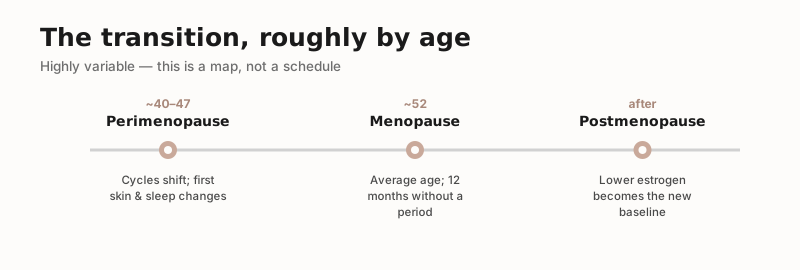
Perimenopause is the transition leading up to menopause — the National Institute on Aging calls it the menopausal transition. Most women begin it between 45 and 55, the average age of menopause in the United States is 52, and menopause-related symptoms can last between two and eight years. But the NIA is explicit that timing and symptoms are highly variable, influenced by genetics, race and ethnicity, lifestyle and environment.
That variability matters more than the averages. Plenty of women notice changes at 41. Plenty notice nothing until 50. Neither means anything is wrong with you.
Underneath, the body’s production of estrogen and progesterone declines substantially. Skin is an estrogen-responsive organ, which is why it is one of the places the shift shows up.
What tends to change in the skin
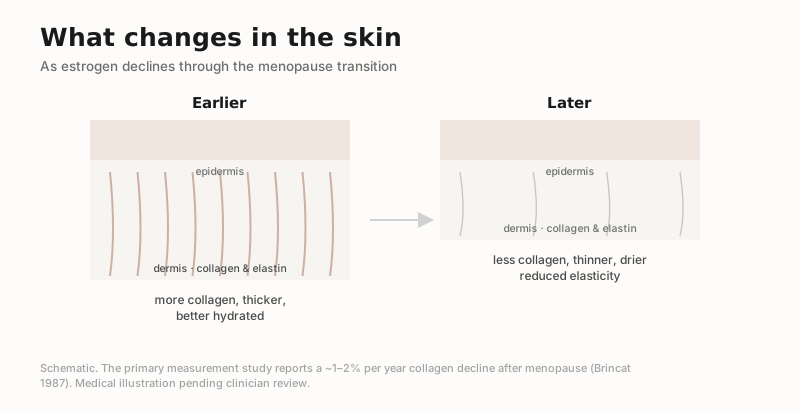
The NIA’s own patient page lists it plainly, alongside the more familiar symptoms: your skin could become thinner and drier. Reduced collagen, decreased elasticity and increased dryness are the changes most consistently associated with menopause in the dermatology literature.
Practically, women describe it as:
- Foundation sitting differently, or looking dry within an hour
- Fine lines that were only visible in motion now visible at rest
- Skin along the jawline and neck feeling softer, less supported
- Slower recovery — a spot or a scratch taking longer to settle
- New itchiness, or sensitivity to products that were fine last year
None of that is a diagnosis, and none of it means you need a procedure. It is a pattern, described so you can recognise it if it is yours.
The statistic we are not going to repeat
Search this topic and within about thirty seconds you will hit a number: thirty percent of skin collagen is lost in the first five years after menopause. It is on hundreds of clinic pages and in product marketing, and it is very likely the reason you clicked on something.
We traced it. The citation trail runs through four papers and terminates in a narrative literature review — not a measurement study — and the figure does not appear in that review’s own abstract. It is also internally inconsistent: 30% across five years is roughly 6% a year, contradicting the "2% per year" quoted in the very same sentence.
Here is the number that does come from a measurement study. In 1987, Brincat and colleagues published in Obstetrics & Gynecology that skin collagen content, skin thickness, metacarpal index and forearm bone mineral content in postmenopausal women "showed a similar decline of between 1–2% per year after the menopause."
That study is small, from 1987, and we could only access the abstract. We are telling you its limitations because a 1–2% figure you can check beats a 30% figure you cannot. A 1999 study in Maturitas using skin biopsies found significantly lower collagen type I and type III in postmenopausal women than premenopausal, inversely correlated with years since menopause — 32 women, also small, pointing the same direction.
The honest summary: collagen declines after menopause, measurably, at a rate best described in low single-digit percentages per year. Anything more dramatic is marketing.
Pigment: melasma and the trigger that actually matters
Melasma — symmetric brown-to-grey patches on sun-exposed facial areas — is one of the changes women most often bring in. It is hormonally influenced: it commonly develops or worsens during pregnancy, or with use of oral contraceptives or hormone replacement therapy.
But that is not the part to act on. Of all the factors involved, chronic light exposure is the most consistent and modifiable trigger, contributing to both onset and relapse. Ultraviolet radiation drives it, and visible light — particularly short-wavelength blue light — has emerged as a clinically significant contributor, especially in people with darker skin phototypes.
So the highest-yield thing available to you is daily, year-round photoprotection, including tinted formulations containing iron oxides, supported specifically because they address visible light rather than UV alone.
Not the exciting answer. The one with the best evidence behind it — and in South Florida it is not optional. NOAA’s climatology for Miami recorded zero clear-sky low-UV days in 2025: 146 days in the Extreme category, 84 Very High, 55 High, 76 Moderate, none Low. The 2024 chart shows the same. The EPA classifies a UV Index of 8 or above as Very High to Extreme, requiring extra protection.
There is no low-UV season here. Worth internalising before you spend money on anything else.
Melasma is also a chronic, relapsing condition rather than something that gets cured. Improvement is frequently temporary without sustained photoprotection and maintenance. Anyone who tells you otherwise is selling you the first phase and skipping the second.
One thing we want to be straightforward about: the mainstays of medical melasma treatment are prescription topicals — hydroquinone-based regimens, tretinoin-containing combinations, oral tranexamic acid in selected cases. We do not offer prescription topicals. If that is the right path for you, the right move is a dermatology referral, and we will say so rather than steer you toward a device because a device is what we have.
Body composition, weight, and the correction that most articles skip
Nearly every article on this subject gets it wrong in one direction or the other, so here are both halves.
What does change: the menopause transition brings genuine, measurable changes in body composition. In the SWAN cohort — a long-running study using DXA scanning rather than the bathroom scale — the rate of fat gain doubled at the start of the transition, and lean mass declined. Those gains and losses continued until two years after the final menstrual period, then flattened.
What does not change: the rate of weight gain. In the same dataset, "weight climbed linearly during premenopause without acceleration" at the transition, and the authors state there is "no discernable change in rate of weight gain at the start of the MT."
Read those together, because separately each misleads. Menopause is not why the scale started moving — it was already moving. Menopause is why the composition of your body changed underneath a number that looks similar. More fat, less muscle, at a similar weight.
This matters for how you feel about yourself. A great many women in their late forties conclude they have lost discipline because the scale stopped responding the way it used to. The DXA data suggests something more specific and less shameful.
The NIA describes the same territory in plainer language: fat distribution changes, the waist can get larger, you can lose muscle and gain fat. It also says women "may gain weight more easily," which sits in some tension with SWAN. We flag that rather than paper over it — SWAN measured body composition directly and found the acceleration in fat mass, not total weight.
Does hormone therapy help skin?
Partly, and less completely than the marketing implies. Both halves of that sentence are load-bearing.
The supportive side. A 2005 review in Climacteric concluded that estrogen treatment in postmenopausal women "has been repeatedly shown to increase collagen content, dermal thickness and elasticity," with data on skin water content described as "promising." An earlier 1987 study found the postmenopausal decline in thigh skin collagen content "was preventable in women who were on sex hormone replacement therapy."
The unsupportive side, from the same review. Results on the effect of hormone therapy on other physiologic characteristics of skin — "elastin content, sebaceous secretions, wrinkling and blood flow" — are discordant. That is the authors' word. It means the studies disagree.
So: reasonable support for collagen content, dermal thickness and elasticity. Genuinely unsettled for wrinkling specifically — which is the outcome most people actually care about when they ask this question.
Both are narrative reviews and small older studies, not modern randomised trials with skin as the primary endpoint. The one-sentence version: hormone therapy is a treatment for menopausal symptoms that may have some effect on skin structure, not a skin treatment. Anyone presenting it as a wrinkle solution is going past the evidence.
If you are weighing it, our hormone therapy programme is the place to have that conversation properly, and how the different delivery methods compare is worth reading first so you arrive with questions.
What actually helps, in order of evidence
1. Photoprotection, daily, year-round. Highest yield, lowest cost, best evidence — and the one most people skip.
2. Address the symptoms that are actually bothering you. Hot flashes, night sweats, sleep disruption, vaginal dryness, mood changes, urinary symptoms. These have treatment pathways, and none require you to justify the complaint first. If any of that is in play, it is a gynecology and hormone conversation before it is an aesthetic one.
3. Skin structure, if laxity is the concern. Morpheus8 is a radiofrequency microneedling treatment used for skin texture and laxity. Before booking anything in this category, read our piece on RF microneedling safety and the FDA’s 2025 communication — we would rather you arrive informed than enthusiastic.
4. Volume, if that is what you are seeing. Sculptra is a collagen-stimulating injectable, working on a months-long timeline rather than a same-week one.
5. Pigment and vascular changes. Intense pulsed light is one option, with an important caveat from the melasma literature: energy-based procedures are among the most debated areas in melasma management. Some patients improve; others relapse or develop post-inflammatory hyperpigmentation, particularly with aggressive settings or inadequate photoprotection. A conservative approach reserves them for selected cases, after topical treatment and photoprotection are optimised. In a city where most of us have Fitzpatrick III–V skin, that caution is not theoretical.
Who is and is not a candidate
You are a reasonable candidate for a conversation if you are noticing changes in your skin, cycle, sleep, mood or body composition in your forties or early fifties. You are not a candidate for anything today — a consultation is an assessment, not a commitment. Bring what you have noticed, including the vague things. "My face looks tired in photographs now" is legitimate clinical information.
Some things make the plan more complicated and should be raised early: pregnancy or planning pregnancy, a history of melasma, a personal or family history affecting hormone therapy candidacy, prior reactions to energy-based treatment, and any current prescription topical. None are automatic exclusions. All change the plan.
Realistic timelines
Everything here works on a slower clock than the marketing suggests, and hormones and skin move on different ones.
- Photoprotection: prevention, not correction. You will not "see results" — that is the point.
- Melasma: an induction phase followed by long-term maintenance. Relapse is common and expected.
- Collagen-stimulating treatment: months, not weeks, by design.
- Energy-based treatment: typically a series. The manufacturer’s own documentation for Morpheus8 describes downtime of one to six days and swelling lasting one to three weeks — notably less favourable than most clinic blogs quote.
- Hormone therapy: set at consultation and monitored with lab work.
Nobody can promise you a result on any of these, and we are not going to.
Side effects and what to take seriously
Energy-based procedures can cause post-inflammatory pigment change, and that risk is higher in darker skin phototypes and higher again with aggressive settings or insufficient photoprotection afterwards. Injectables carry bruising, swelling and injection-site reactions. Hormone therapy carries considerations that belong in a consultation with your history in front of the person advising you — not in an article.
Irritation is its own trap in melasma: irritant contact dermatitis and low-grade inflammation can worsen pigmentation. Aggressive exfoliation and unsupervised combination bleaching products are a common route to a worse outcome than doing nothing.
What this costs
We do not publish prices in articles, because a number without an assessment behind it is not information. Cost is driven by the treatment category, whether you need a series or a single session, whether hormone therapy involves labs and monitoring, and whether maintenance is part of the plan — which for melasma it always is. Current pricing is on our pricing page. If a plan is quoted to you without an assessment first, that is worth questioning wherever you are.
Talk to someone who will look at both
The reason this article exists is that the two halves of this problem are usually treated in separate buildings. Femme Aesthetics & Health offers hormone therapy, medical aesthetics and gynecology in one practice in South Miami, which means the conversation about your skin can include your labs, and the conversation about your hormones can include your face.
If you have been told your symptoms are normal and left it there, that is a common experience and not a good enough answer.
Book a consultation · 7800 SW 57th Ave, Suite 100, Miami, FL 33143 · (786) 250-4133
Sources
- National Institute on Aging, What Is Menopause? — https://www.nia.nih.gov/health/menopause/what-menopause
- Brincat M, et al. "A study of the decrease of skin collagen content, skin thickness, and bone mass in the postmenopausal woman." Obstetrics & Gynecology, December 1987 — https://pubmed.ncbi.nlm.nih.gov/3120067/
- Brincat M, et al. "Decline in skin collagen content and metacarpal index after the menopause and its prevention with sex hormone replacement." British Journal of Obstetrics and Gynaecology, February 1987 — https://pubmed.ncbi.nlm.nih.gov/3828252/
- Brincat MP, Baron YM, Galea R. "Estrogens and the skin." Climacteric, June 2005 — https://pubmed.ncbi.nlm.nih.gov/16096167/
- Affinito P, et al. "Effects of postmenopausal hypoestrogenism on skin collagen." Maturitas, December 1999 — https://pubmed.ncbi.nlm.nih.gov/10656502/
- Greendale GA, et al. "Changes in body composition and weight during the menopause transition." JCI Insight, March 2019 (SWAN cohort) — https://pmc.ncbi.nlm.nih.gov/articles/PMC6483504/
- Melasma. StatPearls, NCBI Bookshelf, January 2026 — https://www.ncbi.nlm.nih.gov/books/NBK459271/
- US EPA, UV Index Scale — https://www.epa.gov/sunsafety/uv-index-scale-0
- NOAA Climate Prediction Center, Daily UV Index — Miami, FL, 2025 — https://www.cpc.ncep.noaa.gov/products/stratosphere/uv_index/gif_files/mia_25.png
Related reading
- Hormone Pellets vs Pills, Patches, Creams and Injections
- Signs You May Benefit From Hormone Therapy
- Gynecology care at Femme Aesthetics & Health
- Morpheus8 · Sculptra · Intense Pulsed Light
This article is for general educational purposes and is not medical advice. It does not diagnose any condition and does not recommend any treatment for you personally. Perimenopause presents differently in every woman, and the research described here has real limitations, which we have tried to state rather than hide. Every procedure and every medication carries risk; discuss yours with a licensed health care provider who has taken your history. Individual results vary and are never guaranteed.