
You’ve done the work. The scale moved, your bloodwork looks better than it has in years, but when you catch yourself in good light you notice something else — your face looks tired, hollow, almost a little older than it should. It has a name now: Ozempic face. And it doesn’t only happen on Ozempic — anyone losing meaningful weight on a GLP-1 medication can experience it. The good news: it’s well understood, it’s manageable, and at our Miami practice, we see it restored beautifully every week.
This content is for educational purposes only and does not constitute medical advice. Individual results may vary. Consult a qualified healthcare provider before undergoing any treatment or procedure.
What Is “Ozempic Face”?
The term “Ozempic face” was coined by a New York Times-featured dermatologist in 2022 to describe the cluster of facial changes that often appear after rapid GLP-1 weight loss: hollow cheeks, deeper smile lines, drawn temples, a less defined jawline, and a generally tired or gaunt look. It isn’t a disease and it isn’t imaginary — it’s simply what happens when you take volume out of the face faster than the skin and connective tissue can adapt.
Despite the name, this isn’t exclusive to Ozempic. We see it in patients on semaglutide, tirzepatide, oral Wegovy, Mounjaro, and Zepbound — really any GLP-1 or GLP-1/GIP therapy that produces meaningful weight loss. It is not a side effect of the medication itself; it is a side effect of fast, real weight loss showing up first in the face.

Why GLP-1 Weight Loss Affects the Face
The face isn’t just one layer of skin over bone — it’s a stack of compartmentalized fat pads, ligaments, muscle, and skin, all working together to give your features lift and definition. When you lose weight quickly, every one of those layers is affected. Here’s what’s actually happening underneath.
Rapid fat reduction in facial fat pads
Your face contains small, organized fat pads — deep medial cheek, superficial cheek, temporal, and others — that give the cheeks their lift, the temples their fullness, and the mid-face its youthful curve. GLP-1 medications shrink these fat pads early in the weight-loss process, sometimes before any clothing fits differently, which is why patients often notice the face change before the body does.
Loss of structural support
When the deep medial cheek, buccal, and temporal fat pads thin out, the overlying skin and ligaments lose their scaffolding. Cheeks flatten and slide downward, the smile lines deepen, and jowls drop slightly forward as the support that used to hold them up disappears. It’s not that you suddenly developed jowls — it’s that nothing is holding the tissue up anymore.
Skin elasticity can’t always keep pace
Skin can shrink with the face only so quickly. If volume disappears faster than collagen and elastin can adapt, the skin develops that draped, drawn quality you see in photos: cheeks that look soft and empty, a jawline that looks crepey, a face that simply doesn’t reflect the body it sits on.
Why the face shows it first
Collagen production declines with age, especially after 35, so the connective tissue in the face is already on a downward slope before any weight loss begins. That’s why facial changes often appear before body changes — the face has the least reserve. If you’re also actively losing weight on a medical weight loss program, planning ahead for facial changes is part of a smart, holistic strategy rather than a vanity afterthought.
Who Tends to Notice It Most
In our Miami practice, the patients who feel the change most are usually those who’ve lost more than 15 to 20 percent of their body weight, are over 35, lost the weight on a faster trajectory of six to nine months, or have a naturally lean facial structure to begin with. Men and women experience it equally; it’s simply more visible when there isn’t much underlying volume to fall back on.
If you see yourself here, please know: the goal of restoration isn’t to undo your progress. It’s to bring the face back into balance with the body you’ve worked hard to build. You can keep the metabolic wins and look like the rested, healthy version of yourself at the same time.
How We Approach Facial Restoration at Femme
The wrong move with Ozempic face is to throw a single syringe of cheek filler at it and hope the rest of the face catches up. It won’t. The face needs to be re-built in layers, in roughly the same order it lost them. Here’s how we structure that process.
Step 1 — Consultation and facial mapping
Every plan starts with an honest assessment of where the volume actually went, where you are in your weight-loss journey, and what your goal weight is. Treating a face that’s still actively shrinking is different from treating one that has stabilized, and we coordinate the plan accordingly — sometimes alongside your weight-loss provider.
Step 2 — Foundational volume
Foundation comes from biostimulators, not bulk filler. Sculptra restores collagen gradually over months, rebuilding structure in the deep cheek and temple regions rather than just adding product on top. The result reads as a return to your own face — not a face that’s been added to.
Step 3 — Targeted contouring
Once the foundation has begun to rebuild, we use precise hyaluronic acid fillers to polish specific areas: a flatter mid-cheek, a soft tear-trough hollow, a jawline that’s lost its edge. This is the “sculpting” step, and it works because the foundation is already there to support it.
Step 4 — Skin quality and tightening
Volume alone won’t fix crepey skin or laxity along the lower face and neck. Morpheus8 RF microneedling tightens the dermis, smooths texture, and gives the skin a firmer, more refined finish. Combined with foundational volume, it’s how we deliver true facial balance — the same philosophy we use in our facial balancing work.
The Treatments That Actually Work
Sculptra — the foundation
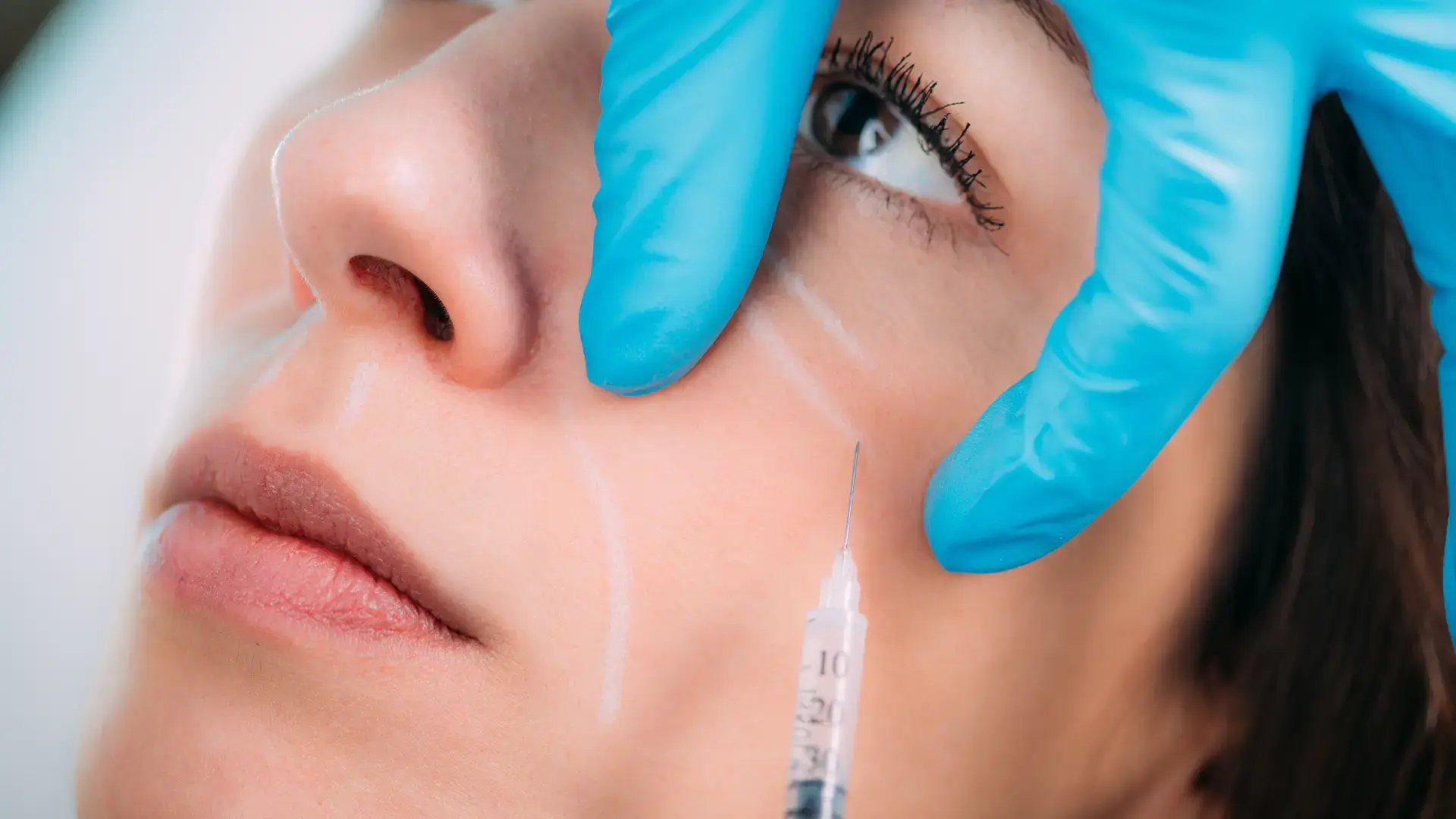
Sculptra is poly-L-lactic acid, a biostimulator that prompts your own fibroblasts to produce new collagen over the months following each treatment. It doesn’t add bulk the way a filler does — it rebuilds the face’s scaffolding from within, which is exactly what GLP-1 weight loss takes away.
For most post-GLP-1 patients, we recommend a series of two to three Sculptra sessions spaced four to six weeks apart, with results that develop gradually and last about two years. It’s the foundation that gives the face its scaffold back, and it’s usually the single most impactful piece of the plan.
Dermal fillers — for definition and balance
Once the Sculptra foundation has set, we layer in dermal fillers — Juvederm, Restylane, RHA — with precision rather than volume for volume’s sake. The right targets are usually mid-cheek projection, under-eye hollows that became more pronounced after weight loss, jawline definition, and temple support.
Here’s the part that surprises patients: the amount of filler used in a post-GLP-1 face is usually less than they expect, because the Sculptra has already done most of the heavy lifting. For specific areas, see our notes on tear trough fillers and under-eye filler tips.
Morpheus8 — for skin quality and mild laxity
Morpheus8 RF microneedling is our go-to for the skin itself: tightening, smoothing, and improving texture. It’s especially useful along the lower face, neck, and jawline where laxity tends to settle after meaningful weight loss, and it pairs beautifully with foundational Sculptra in the same overall plan.
Supporting options
Depending on the patient, we may also weave in neuromodulators such as Botox or Daxxify to soften muscle-pull patterns that drag the lower face down, skin boosters and biostimulators to improve skin quality from within, and a medical-grade skincare protocol to extend the results between treatments. None of these are mandatory — they’re tools we use when they fit the face in front of us.

How to Prevent Ozempic Face While You’re Still Losing Weight
You can’t completely avoid facial change during weight loss, but you can reduce its severity. The patients who fare best on this front share a few habits:
- Pace your weight loss — slower, steadier loss gives skin and connective tissue time to adapt.
- Protect your protein intake — protein is the building block of collagen, and most GLP-1 patients are at risk of under-eating it.
- Strength train — lean mass in the body translates to a healthier, more resilient look in the face.
- Be consistent with skincare and SPF — especially in the Miami sun, which accelerates the same collagen breakdown weight loss is exposing.
- Talk to an aesthetic provider early — even one early Sculptra session can change the trajectory.
At Femme, we deliberately co-locate medical weight loss and aesthetic care under one roof so this conversation can happen in one place rather than three. Coordinating the two is far easier than reverse-engineering it later.
What to Expect — Timeline, Cost Range, Recovery
A realistic Ozempic face restoration plan unfolds across months, not appointments. Months one and two typically include consultation, photos, and the first Sculptra session. Months two to four bring the second and possibly third Sculptra session. Months three to six are when we begin polishing with HA filler, tear-trough work, and Morpheus8 if appropriate. After that, light maintenance keeps the result steady.
Recovery for any single appointment is generally minimal — mild swelling, occasional bruising, and most patients are back to normal activity the same day or next. There’s nothing in this plan that requires you to step out of life for any extended time.
Investment varies depending on how much the face needs and which treatments are involved — this is why a single quote without a consult is usually misleading. For patients who want predictable monthly pricing across the plan, we offer memberships that bundle the most common treatments at a meaningful discount.
Who Is a Good Candidate?
This kind of restoration isn’t universal — the timing matters as much as the technique. A short read on whether now is your moment:
Strong candidate if you are:
- At or near a stable weight (or willing to coordinate around your weight-loss timeline).
- Realistic about a gradual, layered approach rather than an instant fix.
- In good general health with intact, healthy skin.
- Open to combining treatments rather than relying on one product to do everything.
You may want to wait if you are:
- Still in the rapid loss phase of a GLP-1, with significant change ahead.
- Considering pausing or stopping the medication and want to see where your face settles.
- Dealing with an active skin condition that needs to be addressed first.
Why a Personalized Consultation Matters
The biggest risk in treating Ozempic face is over-correcting a face that’s still changing. Filler placed at month three of a year-long weight-loss journey will not sit the same way at month nine, and patients who chase volume too aggressively end up with the pillowy, “done” look they were trying to avoid in the first place. The fix isn’t more product — it’s better timing.
That’s why Femme’s approach pairs aesthetic medicine and medical weight loss under one roof. When the same team is tracking your weight, your bloodwork, and your face, the plan can be sequenced in a way that protects your investment and your appearance — instead of reacting to changes after they’ve already happened.

