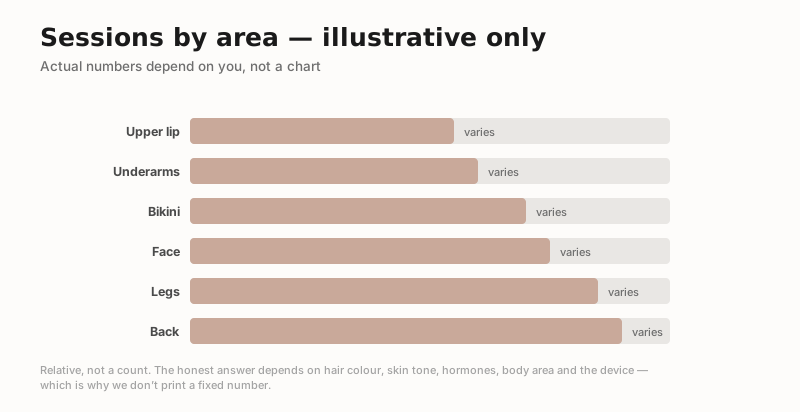
Nobody can tell you the number before looking at your hair and your skin. Laser only affects a follicle while that follicle is in its active growth phase, and yours are not all in that phase at once — so a series is unavoidable. How long the series runs depends on your hair colour and thickness, your skin tone, the body area, your hormones, and the wavelength being used on you.
That sounds like a dodge until you look at what the sources actually say.
Three good sources. Three different numbers.
- The American Academy of Dermatology’s overview page on laser hair removal: "Removing the unwanted hair can take 6 sessions or more."
- The AAD’s own FAQ page: "To remove the hair, most patients need 2 to 6 laser treatments."
- StatPearls, a peer-reviewed clinical reference, frames it as a floor rather than a range: "In the initial phase of hair removal therapy, 4 to 6 sessions spaced 4 to 6 weeks apart are the minimum required to achieve adequate results."
Two pages from the same organisation give figures that don’t line up, and a third gives another range and calls it a minimum. That isn’t sloppiness — it’s what happens when you put one number on something this variable. So this page won’t give you a number. It will tell you what moves it.
Why a series is required at all
The mechanism is selective photothermolysis. The laser emits wavelengths — StatPearls puts the useful band at 600 to 1200 nanometres — that melanin absorbs preferentially. Because melanin is far more concentrated in the hair shaft and matrix than in the surrounding follicle, the pigment in the hair captures the energy and passes it to the structures that produce hair.
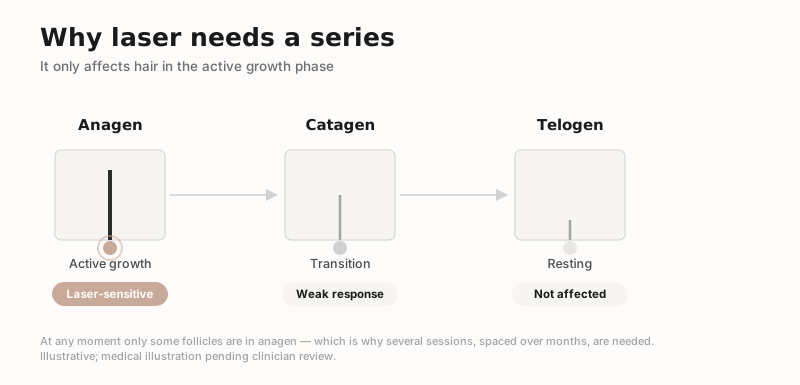
Timing is the catch. StatPearls: "The hair matrix is only sensitive to laser treatment during the anagen phase of the hair growth cycle; therefore multiple treatments will be necessary in order to address all hair follicles when they are most sensitive to treatment."
At any given moment only some of your follicles are in that phase. The rest are dormant and won’t respond that day, no matter how good the operator is. Spacing sessions isn’t scheduling convenience — you’re waiting for dormant follicles to wake into a state the laser can reach. The AAD notes that "most patients can have laser hair removal once every 4 to 6 weeks."
This also explains what alarms first-timers: hair shedding for one to three weeks after a session isn’t new growth. It’s treated hair working its way out.
The six variables
StatPearls lists what changes the outcome. Read it as a consultation checklist — every item is a reason your friend’s plan doesn’t transfer to you.
| Variable | What it means for your number |
|---|---|
| Body area | StatPearls: axillary and pubic hair respond better than hair on the extremities and chest |
| Hair colour and thickness | Less pigment in the hair means less energy absorbed. Blonde, red, grey and white hair are a physical limitation of the technology |
| Skin tone | More pigment in the skin means the skin competes with the hair for the same energy |
| Growth stage | Only anagen hairs respond — the reason for the series |
| Laser type | Wavelength has to suit your skin, not just the hair |
| Hormonal status | Can keep producing new hair regardless of what was treated |
The last one deserves more than a table row.
The hormone variable nobody mentions
The AAD states it plainly about facial hair in women: the result "is not permanent on a woman’s face" because of hormones, and treatment can be repeated when hair regrows. StatPearls lists, among the preparation steps, a "hormonal evaluation to assess causes of hirsutism."
Put simply: laser treats the hair that exists. If something hormonal is driving new hair, that driver is untouched. The honest plan probably includes maintenance. And new or coarsening facial hair, or hair appearing where it never used to, is a medical conversation first and an aesthetic one second.
Wavelength and skin tone
If you have a medium or deep skin tone, this is the section that matters. Skin-type ranges below are as reported by StatPearls.
| Technology | Wavelength | Skin types (StatPearls) | Note |
|---|---|---|---|
| Ruby | 694 nm | I–III | Best in light skin with dark hair |
| Alexandrite | 755 nm | I–III | Greater penetrance; useful on lighter hair |
| Diode | 810 nm | I–V | Penetrates deeper, less epidermal damage, safer in darker skin |
| Nd:YAG | 1064 nm | I–VI | Better penetration, relatively less melanin absorption |
| IPL / broadband light | 500–1200 nm | Usable on darker skin | Not a true laser; covers larger areas; less effective |
StatPearls explains the risk: "Adjacent epidermal structures other than melanin within the hair bulb can compete for absorption, and may cause laser energy to be absorbed by pigment in the epidermis. This hampers the effectiveness of the treatment and causes adverse effects due to adjacent epithelial damage."
The AAD is direct about how much has changed: "In the past, only people with dark hair and light skin could safely have laser hair removal. Today, laser hair removal is a treatment option for patients who have light-colored hair and light skin and patients who have dark skin. Laser hair removal must be performed very carefully in these patients."
The AAD also suggests a question worth memorising: "How many of these laser treatments has the doctor performed on people with my skin coloring?" If you’re weighing laser against broadband light, our intense pulsed light page covers what IPL is for.
Ingrown hairs are a legitimate reason to be here
Plenty of people don’t come for smooth skin. They come because they’re done with bumps.
The AAD opens its laser hair removal overview with exactly that: "Are you tired of shaving, plucking, or waxing? Do you get razor bumps or acne-like breakouts when you get rid of unwanted hair?" StatPearls is more specific, listing pseudofolliculitis barbae — the clinical name for the razor-bump picture — among the medical indications for hair laser, alongside pilonidal sinus and acne keloidalis nuchae.
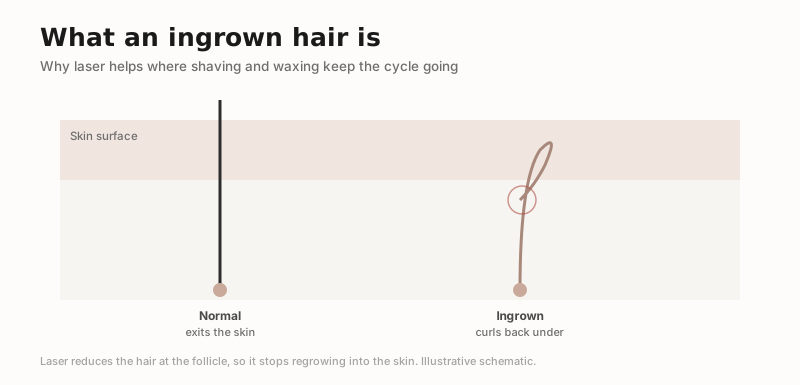
The logic holds. An ingrown hair happens when a cut hair regrows and curls back into the skin. Waxing and plucking remove the hair but leave the follicle producing. Fewer and finer hairs means less that can turn inward.
Two caveats: not every bump is an ingrown hair — folliculitis can be infectious and needs looking at — and an actively inflamed lesion is treated first, not lasered.
Does it hurt?
The AAD’s description: "Many patients say that the laser pulses feel like warm pinpricks or a rubber band being snapped against the skin." That’s a sensory descriptor, not a pain score — it depends on the area, your threshold and the settings.
Some patients use topical numbing gel, most useful on small sensitive areas, which the AAD says "takes about 30 to 60 minutes" to work. That changes how long you’re in the building, so ask when you book.
Worth flagging in advance: pain and anxiety around procedures can trigger vasovagal responses including fainting and low blood pressure, documented in FDA-approved labeling for injectable procedures. If you’ve ever gone grey at a blood draw, say so.
Preparing, and what happens after
The AAD’s pre-treatment instructions are short: "Do not tan (outdoors and indoors). Do not use sunless tanners. Protect your skin by using sunscreen... broad-spectrum, SPF 30+, and water-resistant."
Worth correcting a widespread attribution: the AAD does not publish a number of weeks for sun avoidance before laser. The American Society for Dermatologic Surgery does — two weeks before, at least one week after. If you see "the AAD recommends two weeks," the attribution is wrong.
StatPearls advises avoiding plucking or waxing for six weeks beforehand: the laser needs the root intact to have a target. Shaving doesn’t remove it, so shaving between sessions is fine.
Afterwards, the AAD says laser "generally does not require any real downtime" — skin will be red and swollen immediately after, and most people go back to their day. Common side effects "are minor and last 1 to 3 days": discomfort, swelling, redness. Then sun protection, and no tanning beds.
The risks, stated properly
The AAD’s warning, reproduced in full because paraphrasing it would soften it:
"Laser hair removal can be dangerous in inexperienced hands. Burns, permanent changes to your skin color, and scars can occur."
Other effects — blistering, herpes simplex outbreaks, infection, scarring, skin lightening or darkening — are rare when the procedure is performed by a dermatologist or under direct supervision. And while skin colour tends to normalise, "some changes to skin color, however, are permanent."
StatPearls notes an outcome that surprises people: paradoxical hypertrichosis, more hair rather than less, which "may rarely occur, more commonly in skin type III and with the use of IPL systems."
Which reduces to one point: who operates the device, and which device, matters more than the brand on the brochure.
Are you a candidate?
Good signs: dark, coarse hair in the area that bothers you; expectations set around sustained reduction rather than total elimination; willingness to complete a series and stay out of the sun during it.
Talk it through first if: you’ve tanned recently or used self-tanner; your hair is blonde, red, grey or white; you’re pregnant or breastfeeding; you get cold sores and want the mouth area treated; you take anything that increases photosensitivity; or you suspect a hormonal driver. None of these is an automatic no — they’re reasons to have your skin looked at first.
What drives the cost
No prices here, because the real number depends on things only visible in person. What moves it: area size — the AAD notes the upper lip takes minutes while the back or legs "may last more than an hour"; the number of sessions; whether you’ll want maintenance on hormonally influenced facial areas; whether you’re treating multiple areas in one visit; and whether you use numbing gel, which lengthens the appointment.
Current pricing is on our pricing page. One warning about comparing quotes: two six-session packages aren’t comparable if the wavelength isn’t right for your skin tone, or if the operator has limited experience with pigmented skin.
The Miami problem
There is no low-sun season here, and that changes the practical advice. NOAA Climate Prediction Center data records zero clear-sky low-UV days in Miami in 2025 — 146 days extreme, 84 very high, 55 high, 76 moderate, 0 low. 2024 confirms it: 140, 102, 64, 59, 0. (Modelled clear-sky values; the cloud-adjusted series shows 20 low days.) The EPA classifies UV 8 and above as "Very High to Extreme — Extra protection needed."
What follows: the AAD’s no-tanning instruction isn’t seasonal here — January and July are the same instruction. Tanning is mostly unintentional, a weekend on the water or the walk from the car, and it still counts. And the conventional "start in autumn" advice doesn’t transfer, because the limiting factor is your routine, not the calendar.
If you spend your life outdoors, say so. It changes the plan.
Next step
If you came for a number, you now know why you didn’t get one. What we can do is look at your hair and skin, raise the hormonal question if the pattern suggests it, and match the technology to your skin tone.
See our laser hair removal service, read about Brazilian laser hair removal if that’s the area you’re asking about, or book a consultation in South Miami.
Related reading: between sessions and afterward, what you can and can’t do in the sun, pool and gym matters more here than almost anywhere, given the year-round Miami UV.
Educational disclaimer
This content is for information only. It is not medical advice, diagnosis or treatment, and it does not create a provider-patient relationship. Laser hair removal is a medical procedure with real risks including burns, pigment change and scarring. Candidacy, session count and settings can only be determined by a licensed professional at an in-person evaluation. Do not start or stop any medication based on this article. Results vary between individuals and no outcome is guaranteed.
Related articles
- Laser Hair Removal — the service, areas treated, what to expect
- Brazilian Laser Hair Removal — the most-asked area, in detail
- Intense Pulsed Light — how IPL differs from a laser
- Pricing